
BMEssentia Platform / Courses / MRI Physics
Course: Translational & Clinical Technologies
MRI Physics
Imagine seeing inside the body in vivid detail without ever making an incision, MRI physics makes this a reality. This course takes you into the core of Magnetic Resonance Imaging (MRI) technology, where magnets, radio waves, and protons align to create some of the most detailed medical images available. Covering everything from magnetic field fundamentals to advanced imaging techniques, you'll gain a deep understanding of how MRI works and how to optimize its use in medical diagnostics. Through each module, you'll dive into crucial topics like magnetic resonance, the role of gradient and RF.
14 chapters. Online and self-paced, in English, on the BMEssentia Platform.
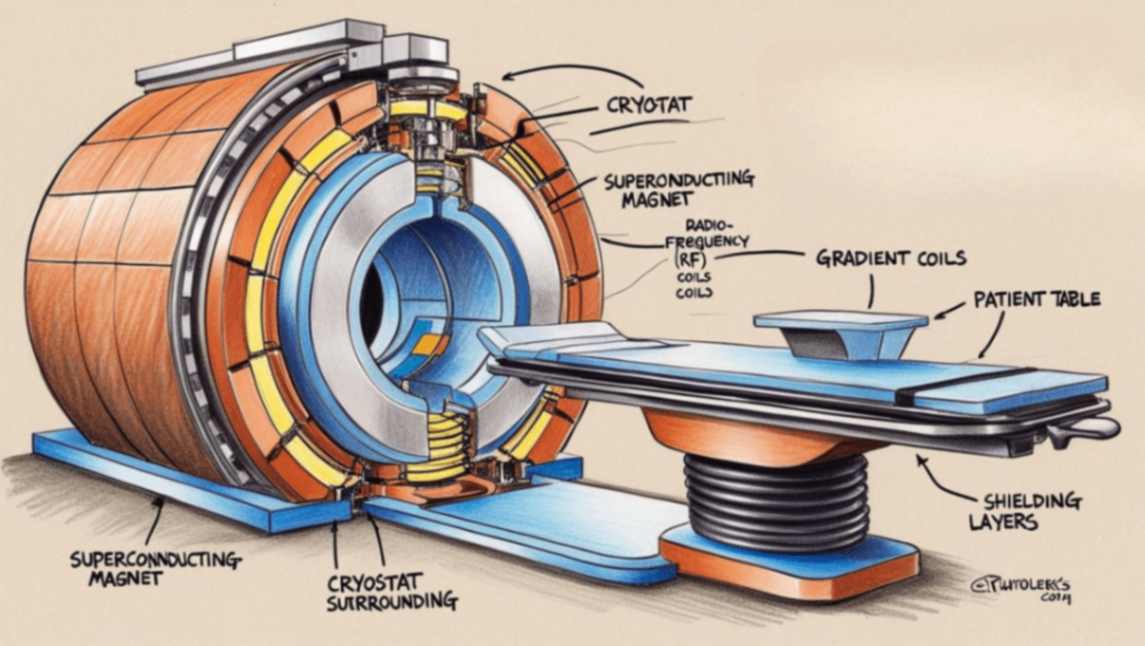
What you will learn
- Understanding MRI Magnet Types: Learn the differences between permanent, resistive, and superconducting magnets and their applications in MRI.
- Gradient Coils and Spatial Encoding: Master the use of gradient coils for precise spatial encoding, vital for creating accurate 3D body images.
- RF Coil Design and Signal Reception: Explore the design and function of RF coils in transmitting and receiving signals, crucial for capturing clear images.
- Proton Spin and Precession Mechanics: Understand the principles of proton spin and precession that form the foundation of MRI imaging.
- Shimming and Field Homogeneity: Learn shimming techniques to ensure magnetic field uniformity, reducing image distortions and improving quality.
- T1 and T2 Relaxation Dynamics: Delve into relaxation times and how they contribute to MRI image contrast for different tissues.
- K-Space Fundamentals and Image Reconstruction: Gain skills in K-space navigation, essential for converting raw MRI data into detailed images.
- Larmor Frequency and Flip Angle Control: Discover how frequency and flip angles impact image contrast and resolution.
- Artifact Reduction Techniques: Identify and mitigate common MRI artifacts to ensure the highest image quality
- Applications of MRI Physics in Clinical Settings: Learn how to apply MRI principles to various diagnostic applications, from brain scans to cardiovascular imaging.
Modules
- Magnets and Scanners
- Types of Magnets
- Homogeneity, Shimming
- Gradient Coils
- RF Coils, MR Site Planning
- The NMR Phenomenon, Spin, Precession
- Resonance, Larmor Frequency, Flip Angle
- Relaxation-Physics, T1, T2
- Pulse Sequences, Gradient Echo, TR and TE, Spin Echo
- Image Contrast (Short and Long TR/TE)
- Inversion Recovery, Choice of IR Parameters
- Making an Image, Phase and Frequency, Real and Imaginary, Fourier Transform
- Frequency Encoding, Phase Encoding
- K-Space, Parts of K-Space
More courses
- Bio-Mechanics12 chapters
- Bio-Nanotechnology14 chapters
- Biomaterials14 chapters
- BioStatistics14 chapters
- Cell and Tissue Engineering14 chapters
- Chemistry of Life12 chapters
Learn it properly, inside the Platform
22 courses, the 69-device library with 13 sections per device, BMEssentials and BMEssence guides and MedTech AI. Start with a 7-day free trial, no card.
Start the 7-day free trial