
BMEssentia Platform / Device library / Spirometer
Device library
Spirometer
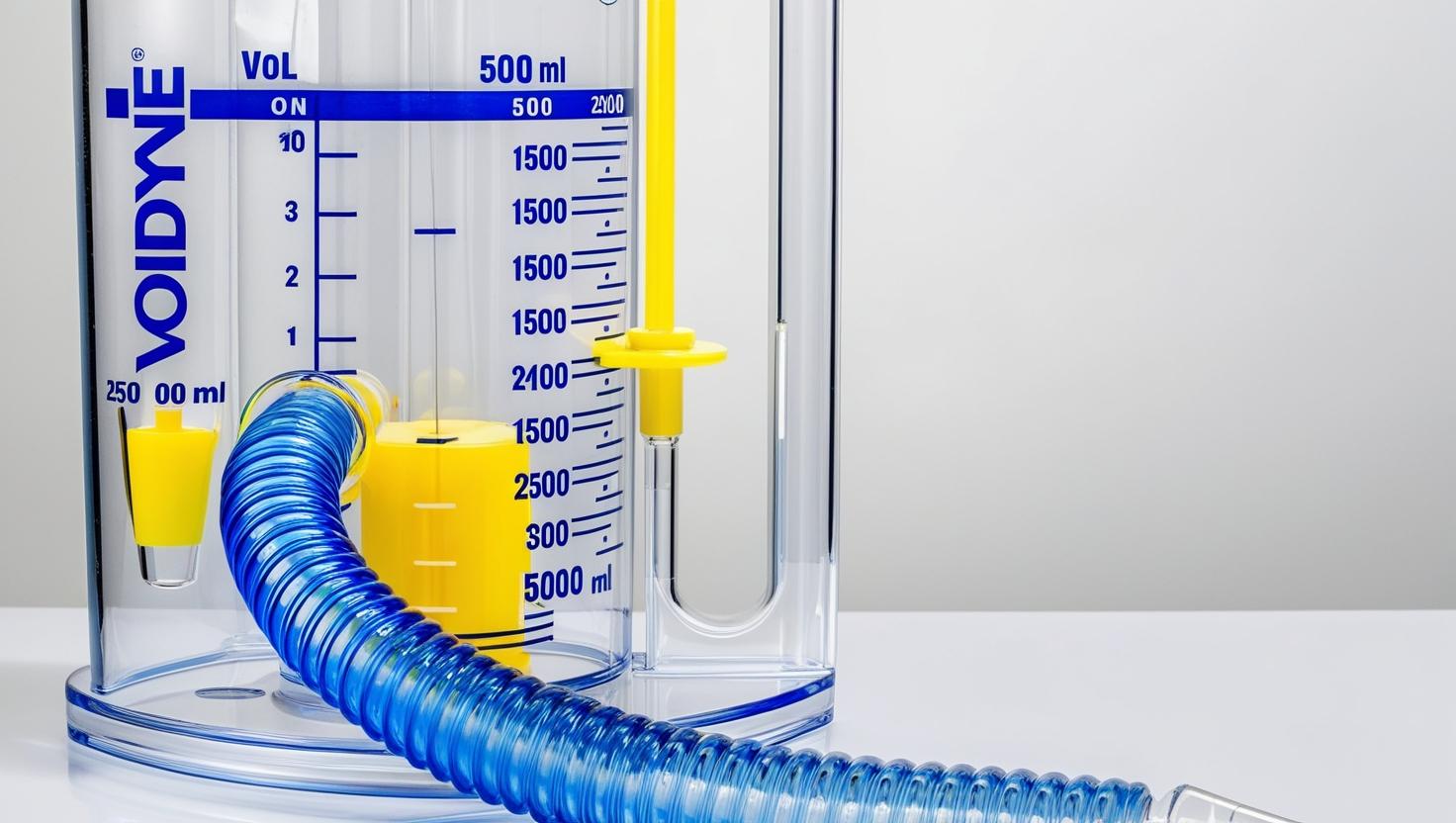
A spirometer is a medical instrument used to assess lung function by measuring the volume and speed of air that a person can inhale and exhale. The most common test performed with this device is called spirometry, where an individual breathes into a mouthpiece connected to the machine. This test helps healthcare professionals diagnose and monitor various respiratory conditions, including asthma, chronic obstructive pulmonary disease (COPD), and cystic fibrosis. Key measurements obtained from a spirometry test include the forced vital capacity (FVC), which is the total amount of air one can forcefully exhale after a full inhalation, and the forced expiratory volume in one second (FEV1).
The 13 sections, in brief
Short summaries of each section. The full lessons, images and quizzes are in the Platform.
Overview
A man of fifty-eight sits in a small room at his local surgery. He drives buses. He smoked for most of his adult life and stopped a few years ago. For a while now, the stairs to his flat have left him stopping halfway. He puts it down to age, to weight, to not being as fit as he was. Nobody has ever told him otherwise.
Operations
Follow the air from the bottom of the lungs to the number on the report. It starts with the deepest breath the patient can take. The lungs fill until the chest wall and diaphragm can pull no further. This is the starting line. A breath that is not truly full shortens every measurement that follows, and nothing in the result will show it.
Importance
The first argument is about finding disease that hides. The lungs have an enormous reserve. A person can lose a large share of their lung function and still feel well at rest. Breathlessness on stairs gets blamed on age, weight or fitness. By the time symptoms force a visit, much of the damage has been done.
Physics
Physics Involved in the Spirometer Device: Concept 1, Principle of Lung Volume and Airflow Measurement in a Spirometer A spirometer is a device that measures how much air a person can inhale and exhale, and how fast that air moves in and out of the lungs. It turns something invisible-breath-into numbers and waveforms that show how well the lungs work.
Features
The flow sensor, the device's only direct measurement Everything a modern spirometer reports comes from one thing: how fast air is moving through the sensor at each instant. Imagine a spirometer that could only measure how much air arrived, collected in a bag, with no sense of time. You would know the total. You would not know whether it came out in one second or ten.
Applications
Every use of this device is one of four things. Diagnosing airway disease. Monitoring how lungs change over time. Deciding whether a patient can safely have a treatment or operation. And watching over people exposed to risk. The first is where most spirometry happens. The second is where it quietly does the most good.
Physiology
The airways are a branching tree whose resistance lives in surprising places. The lungs are springs that empty themselves. Past a certain effort, harder blowing does not make air come out faster. The spirometer cannot see the air that never leaves. Lung diseases change the blow in two different ways. And lungs grow, peak and decline across a lifetime.
Safety
The spirometer rarely hurts anyone directly; the real danger is a wrong diagnosis produced by a test that looked right. Most harm from spirometry comes from belief in a poor test. A weak blow read as disease. A wrong reference equation. A device that drifted. Each produces a clean, professional report that sends a patient down the wrong path for years.
Advancements
Forget release years. This device has a clear shape: it began by measuring how much air a person could move, discovered that how fast they moved it mattered more, and then spent generations learning how to trust the effort and define what normal means.
In Research
Nobody has settled what normal lungs should look like for everyone Spirometry is one of the oldest and most widely used lung tests. Yet the definition of normal is still argued over. Which populations should reference equations be built from? Should ancestry be included? How should age be handled?
Logistics
An engineer who understands this device is useful. An engineer who understands that the spirometer is cheap and a good test is expensive, because the value lives in trained operators, calibration and disposables rather than in the box, understands what is actually being sold.
Alternatives
An alternative is not a competing product. It is another way of answering the clinical question, and here the question is: is air moving in and out of this person's lungs normally, and if not, is the problem in the airways, the lung tissue, the chest wall, the muscles, or somewhere else entirely?
Ethical
A few seconds of blowing into a tube can decide a person's treatment, their job, their compensation and whether they are offered surgery. The spirometer turns one breath into a label, and labels travel. A diagnosis written from a single test follows the person into prescriptions, insurance forms, work medicals and future consultations.
Previous: SPECT Scanner. Next: Stethoscope. All 69 devices.
Learn it properly, inside the Platform
22 courses, the 69-device library with 13 sections per device, BMEssentials and BMEssence guides and MedTech AI. Start with a 7-day free trial, no card.
Start the 7-day free trial