
BMEssentia Platform / Device library / Surgical Stapler
Device library
Surgical Stapler
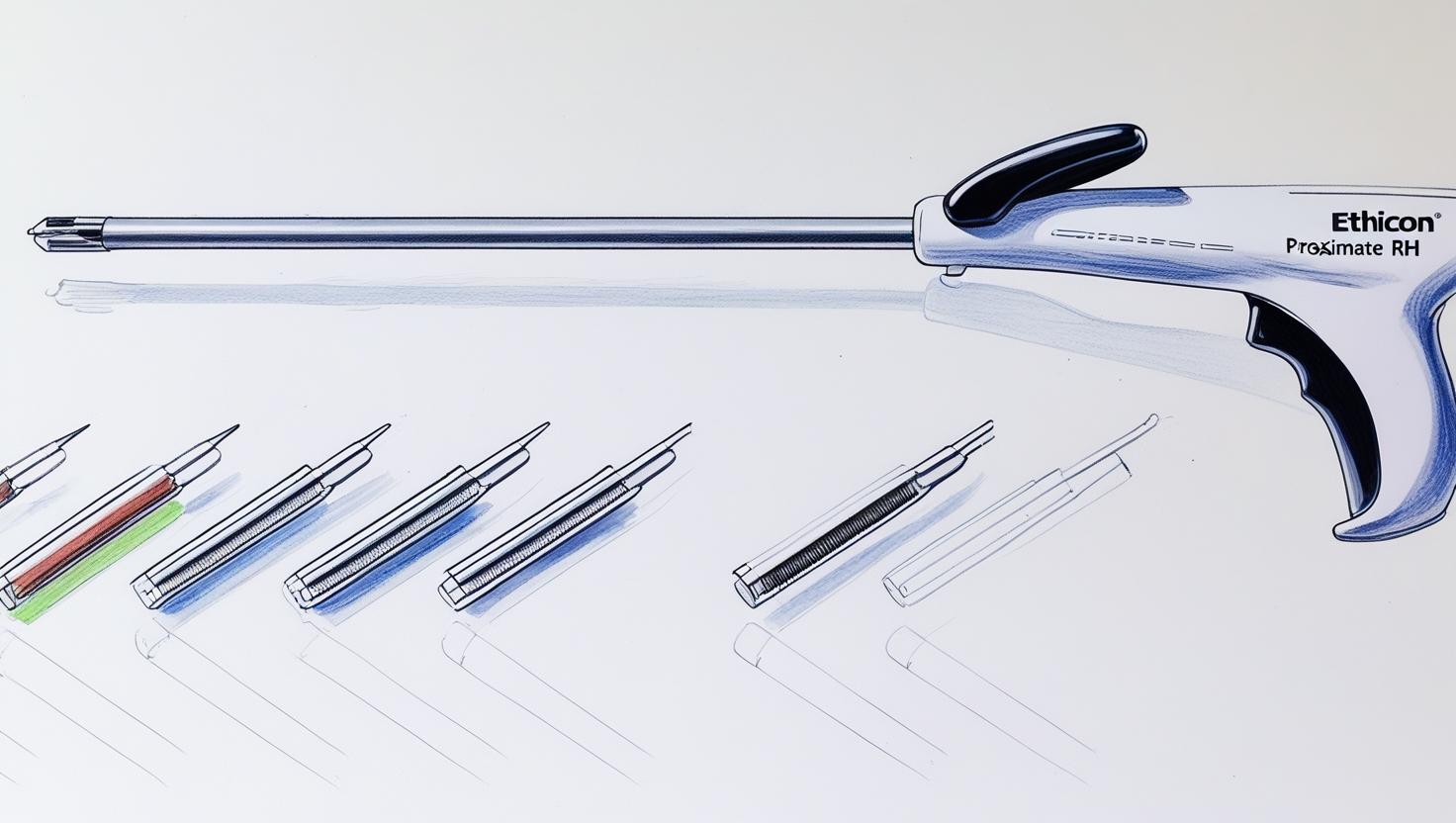
A surgical stapler is a specialized medical device that places rows of sterile staples to close incisions or connect tissues during operations. These precision instruments come in linear, circular, and curved designs for various procedures from bowel resections to skin closures. Modern staplers feature ergonomic handles, rotating shafts, and color-coded cartridges for different tissue thicknesses. Some advanced models incorporate bioabsorbable staples that dissolve after healing or wound monitoring sensors. They significantly reduce operation time compared to traditional suturing while maintaining secure wound closure. Used in minimally invasive and open surgeries alike, staplers have.
The 13 sections, in brief
Short summaries of each section. The full lessons, images and quizzes are in the Platform.
Overview
A man of sixty has a cancer in his rectum. It sits about six centimetres above the opening of his bowel, deep in the narrow bony funnel of the pelvis. Two generations ago, a cancer that low usually meant one operation: removing the rectum and the anus completely, and bringing the end of the bowel out through a hole in the abdominal wall, into a bag, for the rest of his life.
Operations
Follow the tissue into the jaws, and follow the staple through it. It starts with a choice of device. A linear cutter lays rows of staples and cuts between them, dividing and sealing tissue in one action. A linear stapler lays rows without cutting. A circular stapler joins two tubes end to end. A skin stapler closes wounds.
Importance
The first argument is about joins that hands cannot make well. Some joins are in places where sewing by hand is extremely difficult: deep in the narrow pelvis, high in the chest where the oesophagus meets the stomach, or through the small ports of keyhole surgery.
Physics
Physics Involved in the Surgical stapler Device: Concept 1, The Mechanical and Biomechanical Fundamentals of Surgical Stapling The surgical stapler is not just a mechanical tool, it's a controlled compression and deployment system that transforms the physics of pressure and metal deformation into safe, blood-tight tissue approximation.
Features
Start here, because everything depends on how a staple closes. A tiny U-shaped piece of wire, usually titanium, with two sharp legs. The legs are pushed through the tissue and hit shaped pockets in the anvil, which bend them inward and back into the shape of a letter B.
Applications
Every use of this device is one of four things. Dividing and sealing tissue. Joining two parts of a tube. Closing an opening. Or closing skin. The first two carry most of the risk, and most of the benefit. Removing part of the bowel for cancer, inflammation, blockage or injury, and joining the remaining ends.
Physiology
A stapler is judged in the second it fires. The patient is judged days later, by a process the stapler takes no part in. Everything this device does is a bet on biology. It puts two cut edges together, squeezes them, pins them, and hands the job to the body. If the body cannot finish the job, no staple can finish it instead.
Safety
Most devices hurt people while they are running, but the stapler hurts people after it has been thrown away. The most dangerous staple line is the one everyone in the room agreed looked fine. Its failures arrive at three times: the moment of firing, the hours after, and the days after. Only the first happens in front of anyone. Safety here means building checks for things nobody can see yet.
Advancements
Forget release years. This device has a clear shape: skill moved out of the surgeon's hands and into the cartridge, and then the field discovered which parts of that skill could never move. Every join by hand, so the quality of the join was exactly the quality of the hands, and operations were long.
In Research
Nobody can yet say, at the moment of firing, which join will leak Stapled joins are made in enormous numbers every day. At the second of firing, the team knows the tissue, the device and the patient. They still cannot say whether this join will hold. If a leak could be predicted in theatre, surgery would change overnight.
Logistics
An engineer who understands this device is useful. An engineer who understands that the handle is sold once and the reloads are sold every case for years understands what is actually being sold. Almost none of this device's money is in the part you can see. It is in small boxes that keep arriving, sitting on shelves, expiring and being counted. Whoever manages that flow well wins the account.
Alternatives
An alternative is not a competing product. It is another way of answering the clinical question, and here the question is: how do these two edges become one, and should they be joined at all today? Hand-sewing, the skill everything else rests on What it is. The surgeon joins the edges with stitches, choosing depth, spacing and tension at every point.
Ethical
The stapler's decisions are made in theatre, and its harms land days later on a ward. When the person who decides and the person who suffers are separated by a week and a corridor, ethics has to do the work that feedback cannot. The team rarely sees what its choices cost. The patient never saw the choices at all. Everything below is about closing that distance.
Previous: Surgical Robots. Next: The Anesthesia Machine. All 69 devices.
Learn it properly, inside the Platform
22 courses, the 69-device library with 13 sections per device, BMEssentials and BMEssence guides and MedTech AI. Start with a 7-day free trial, no card.
Start the 7-day free trial