
BMEssentia Platform / Device library / Cardiopulmonary Bypass Machine
Device library
Cardiopulmonary Bypass Machine
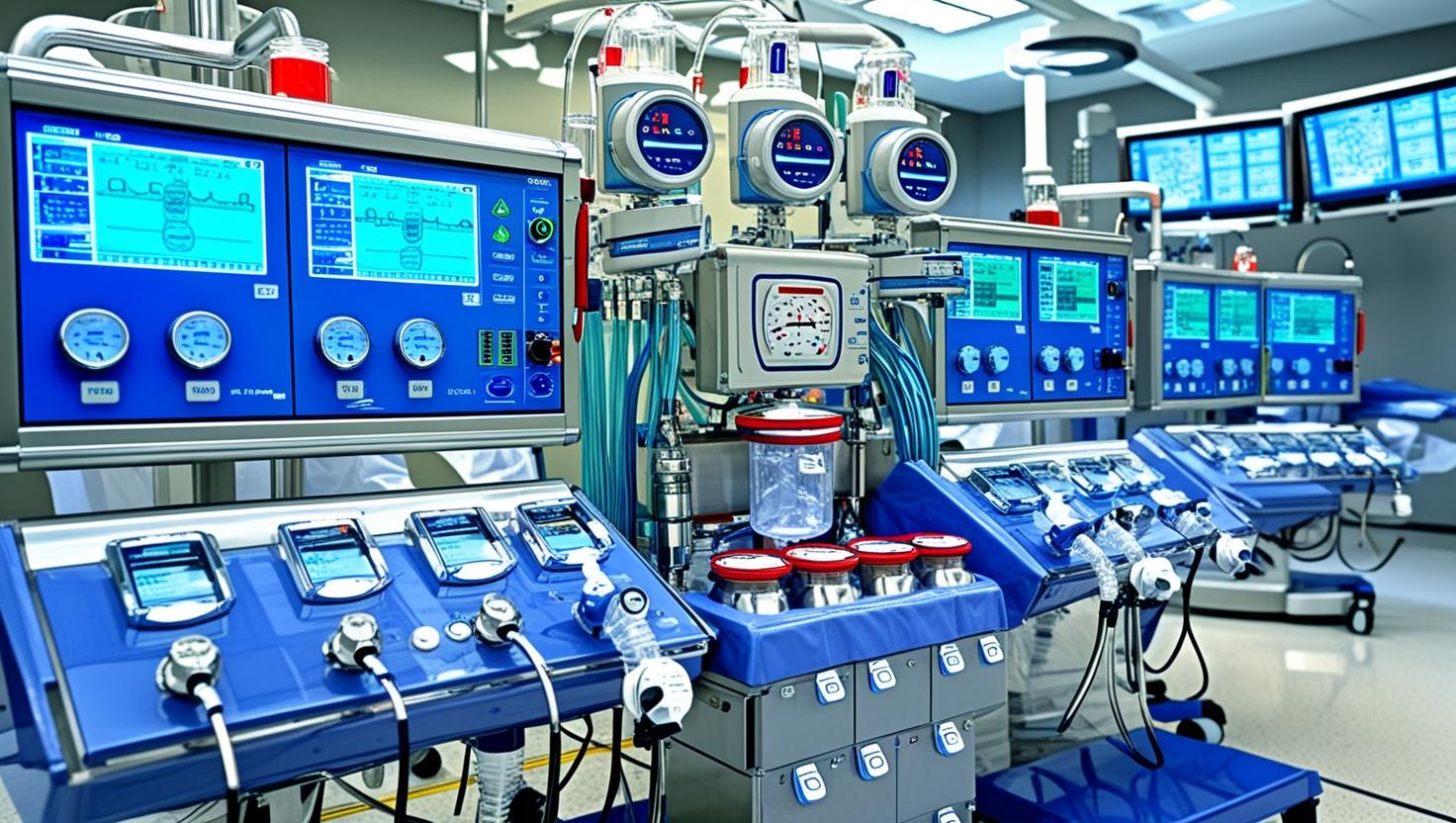
The cardiopulmonary bypass machine, first successfully used in 1953 by Dr. John Gibbon, temporarily takes over heart and lung functions during open-heart surgery. Nicknamed the "heart-lung machine," it oxygenates and circulates blood, allowing surgeons to operate on a still heart. Modern machines are compact, with advanced monitoring to adjust blood flow precisely, supporting up to 6 hours of bypass. They've enabled complex procedures like valve repairs and coronary bypass, saving millions of lives annually.
The 13 sections, in brief
Short summaries of each section. The full lessons, images and quizzes are in the Platform.
Overview
There is a moment in cardiac surgery that people outside the room do not quite believe when they hear it described. The chest is open, the sternum split and held apart, the pericardium tented back, and a heart is beating in front of six people. Cannulas have been sewn into the great vessels: one draining the venous return before it reaches the right atrium, another delivering blood back into the aorta.
Operations
Follow the blood and the machine explains itself. Venous blood, returning from the body toward the right side of the heart, is intercepted before it gets there by a cannula placed in the right atrium or in the great veins.
Importance
The case for this machine is simple and it is total: it made cardiac surgery possible, and without it essentially nothing that is now done to hearts could be done at all.
Physics
Physics Involved in the Cardiopulmonary Bypass (CPB) Machine: 1, Core Functional Architecture & Blood Circuit Pathway The Cardiopulmonary Bypass (CPB) Machine is the ultimate biomechanical bridge between human physiology and mechanical engineering, a device capable of temporarily replacing both the heart and the lungs.
Features
The venous reservoir, and the buffer that makes everything else possible Start here, because it is the least glamorous component and the one that keeps the operation alive. Blood drains from the patient by gravity. A cannula sits in the right atrium or in the great veins, a tube runs downward, and the weight of the column of blood pulls it out.
Applications
Coronary artery bypass grafting, the highest volume use The commonest cardiac operation in the world, and the clinical problem is straightforward to state. Coronary arteries narrow. Muscle downstream is starved. The surgical answer is to build a new route around the blockage using a length of the patient's own artery or vein.
Physiology
No device in this library requires more physiology than this one, and the reason is simple. Every other machine measures something the body is doing. This one replaces what the body is doing, which means every homeostatic mechanism that normally runs without instruction has become a setting somebody must choose.
Safety
Here is the sentence that governs everything in this section, and once you have accepted it the rest of the machine's design stops looking paranoid. If this machine stops, the patient has no circulation at all. Not a reduced circulation. None. And a warm brain has a few minutes before the damage is permanent.
Advancements
Forget release years. The shape is what predicts direction, and this device has an unusual shape because its progress has been almost entirely about reducing harm rather than increasing capability. The desperate era.
In Research
This device has been in continuous clinical use for generations. Millions of people are alive because of it. Every parameter it controls is measured, displayed and recorded. Nobody can tell you whether a pulsatile circulation matters, which is a question about whether the machine should imitate a heart or merely replace one, and it has been argued since the device was invented.
Logistics
An engineer who understands how a bypass circuit works is useful. An engineer who understands that the capital equipment is almost free and the disposables are the entire business runs a distributorship. This device has an economic structure unlike anything else in this library, and it is the structure that matters commercially rather than the machine.
Alternatives
An alternative is not a competing product. It is another way of achieving the clinical goal, and the goal here is not "use a bypass machine". It is to fix something wrong with a heart or an aorta and have the patient survive it in good condition. Which reframes the whole section, because the most important alternatives to this machine are not other machines.
Ethical
Most devices in this library raise ethical questions about how they are used. This one raises a question about what it means to be alive. A patient on full support has no heartbeat generating their circulation and no breathing producing their gas exchange. Both functions have been transferred to a machine.
Previous: Cardiac Pacemaker. Next: Centrifuge. All 69 devices.
Learn it properly, inside the Platform
22 courses, the 69-device library with 13 sections per device, BMEssentials and BMEssence guides and MedTech AI. Start with a 7-day free trial, no card.
Start the 7-day free trial