
BMEssentia Platform / Device library / Colonoscope
Device library
Colonoscope
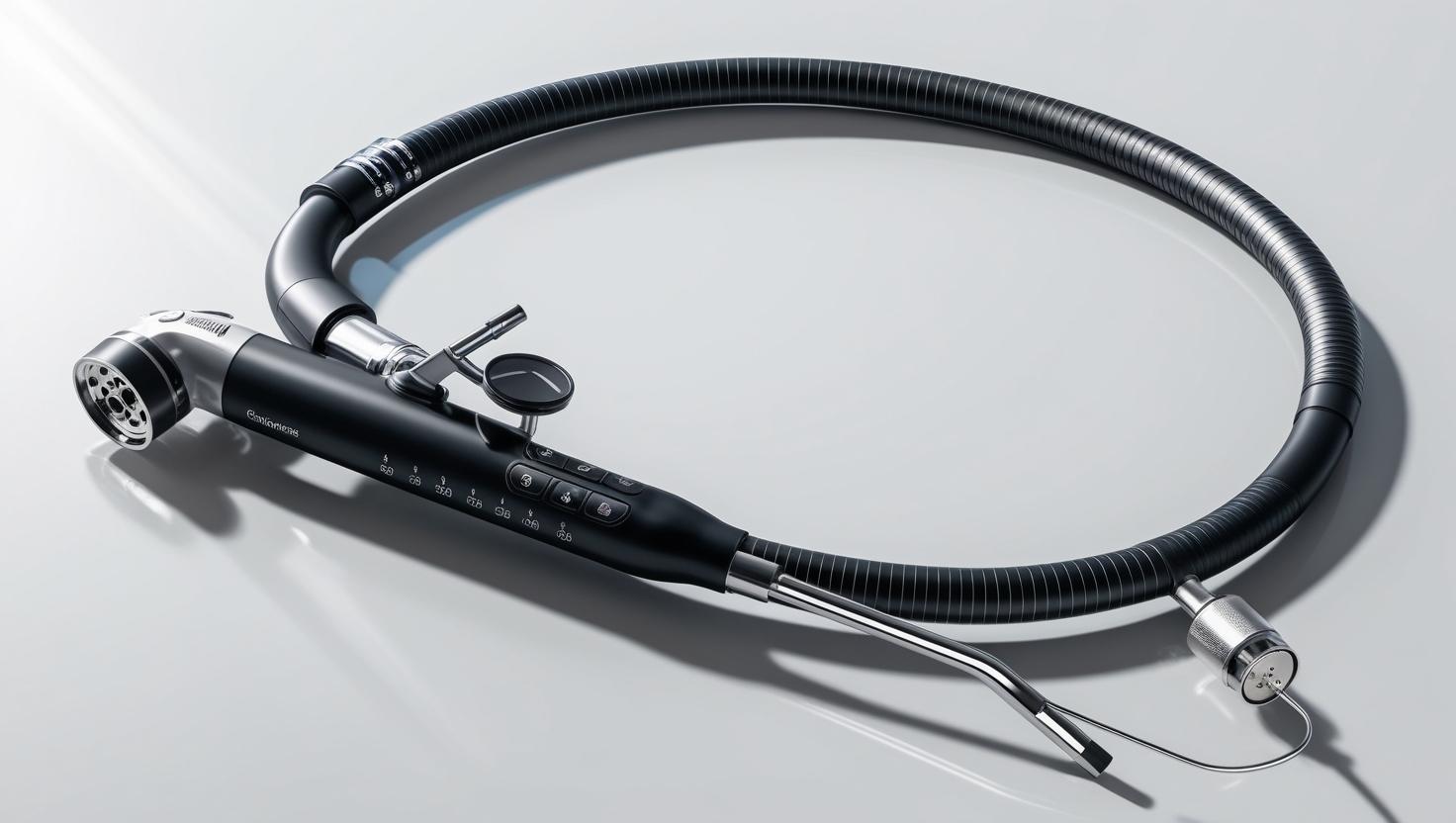
A colonoscope is a flexible, lighted tube used to examine the entire colon and rectum for abnormalities during a colonoscopy procedure. This vital diagnostic tool features a high-resolution camera, illumination system, and channels for air/water delivery and instrument passage. Modern colonoscopes incorporate advanced imaging technologies like narrow-band imaging and magnification to detect subtle mucosal changes. They allow for both diagnostic evaluation and therapeutic interventions such as polyp removal or biopsy collection. The device's articulating tip and variable stiffness shaft enable navigation through the colon's complex anatomy with improved patient comfort. Recent advancements.
The 13 sections, in brief
Short summaries of each section. The full lessons, images and quizzes are in the Platform.
Overview
A man of fifty-eight is lying on his left side and the endoscopist has stopped pushing. They have been at the same bend for four minutes. The scope has gone in ninety centimetres and the tip has moved about twenty. Every time they push, the picture on the screen stays exactly where it is, and the resistance in their right hand keeps building.
Operations
Follow the insertion, because in this device insertion is the skill and everything else is shared with the rest of the endoscope family. It starts with the patient on their left side. That position places the sigmoid colon favourably, lets fluid pool away from the airway, and is the position from which the rest of the procedure is planned.
Importance
The first argument is the strongest available for any device in this library, and it needs stating precisely because it is frequently blurred into ordinary screening language. Colonoscopy prevents cancer rather than detecting it early. The adenoma to carcinoma sequence takes years. A polyp removed today is a cancer that does not occur in five or ten years' time.
Physics
Physics Involved in the Colonoscope Device: Concept 1, Structural and Optical Architecture of the Colonoscope A colonoscope is a precision-engineered, flexible endoscopic instrument designed to navigate the human colon's convoluted geometry while transmitting high-fidelity visual and mechanical feedback to the operator.
Features
Start with the number, because it is frequently misunderstood. A standard adult colonoscope is around one hundred and thirty to one hundred and sixty centimetres of working length. The colon itself is around one hundred and fifty centimetres. The scope is not threaded along the full length of the colon like a wire through a pipe. The colon is shortened onto the instrument as it advances.
Applications
Examining people with no symptoms at all, which is a strange thing to do and is justified by the biology. Why it works here and not for most cancers. The precursor is visible, reachable and removable, and it takes years to become malignant. Which gives a long window during which an intervention lasting two minutes eliminates a disease that would otherwise take years of treatment and frequently kill.
Physiology
How the colon is built and held, which explains looping. How a polyp becomes a cancer, which explains why removing it works. And how the wall is layered, which explains what can be removed endoscopically and what cannot. Fixed and mobile, and why it decides everything
Safety
The defining safety fact about this device is who it is performed on. Screening colonoscopy is done on people who feel completely well and have no symptoms. They were invited by a letter. Which sets the acceptable risk far lower than for a procedure somebody needs, because every complication happens to a person who would have been perfectly fine that week if nobody had written to them.
Advancements
Forget release years. This device has a distinctive shape: the hardware improved steadily, and the largest gains came from technique and from measurement rather than from the instrument. Rigid sigmoidoscopy, which reached the last twenty-five centimetres and nothing else. Most of the colon was inaccessible.
In Research
Two endoscopists. The same unit, the same scopes, the same screening population, the same guidelines. One finds an adenoma in a quarter of patients. The other in a half. And the patients examined by the first go on to develop colorectal cancer at a measurably higher rate. That relationship is established and reproduced.
Logistics
An engineer who understands this device is useful. An engineer who understands that a national screening programme is a logistics problem wearing a clinical coat understands what is actually being sold.
Alternatives
An alternative is not a competing product. It is another way of answering the clinical question, and here the question splits sharply. If you need to remove something, nothing else in this section can do it. If you only need to work out who should have a colonoscopy, several things are better than doing colonoscopies on everybody.
Ethical
This device is performed on people who feel completely well. Somebody receives a letter, drinks several litres of purgative, takes a day off work, is sedated, and has an instrument passed a metre and a half into their body, because a health system invited them. They had no symptoms. They were not worried about anything.
Previous: Cochlear Implants. Next: Computed Tomography. All 69 devices.
Learn it properly, inside the Platform
22 courses, the 69-device library with 13 sections per device, BMEssentials and BMEssence guides and MedTech AI. Start with a 7-day free trial, no card.
Start the 7-day free trial