
BMEssentia Platform / Device library / Cranial Drill System
Device library
Cranial Drill System
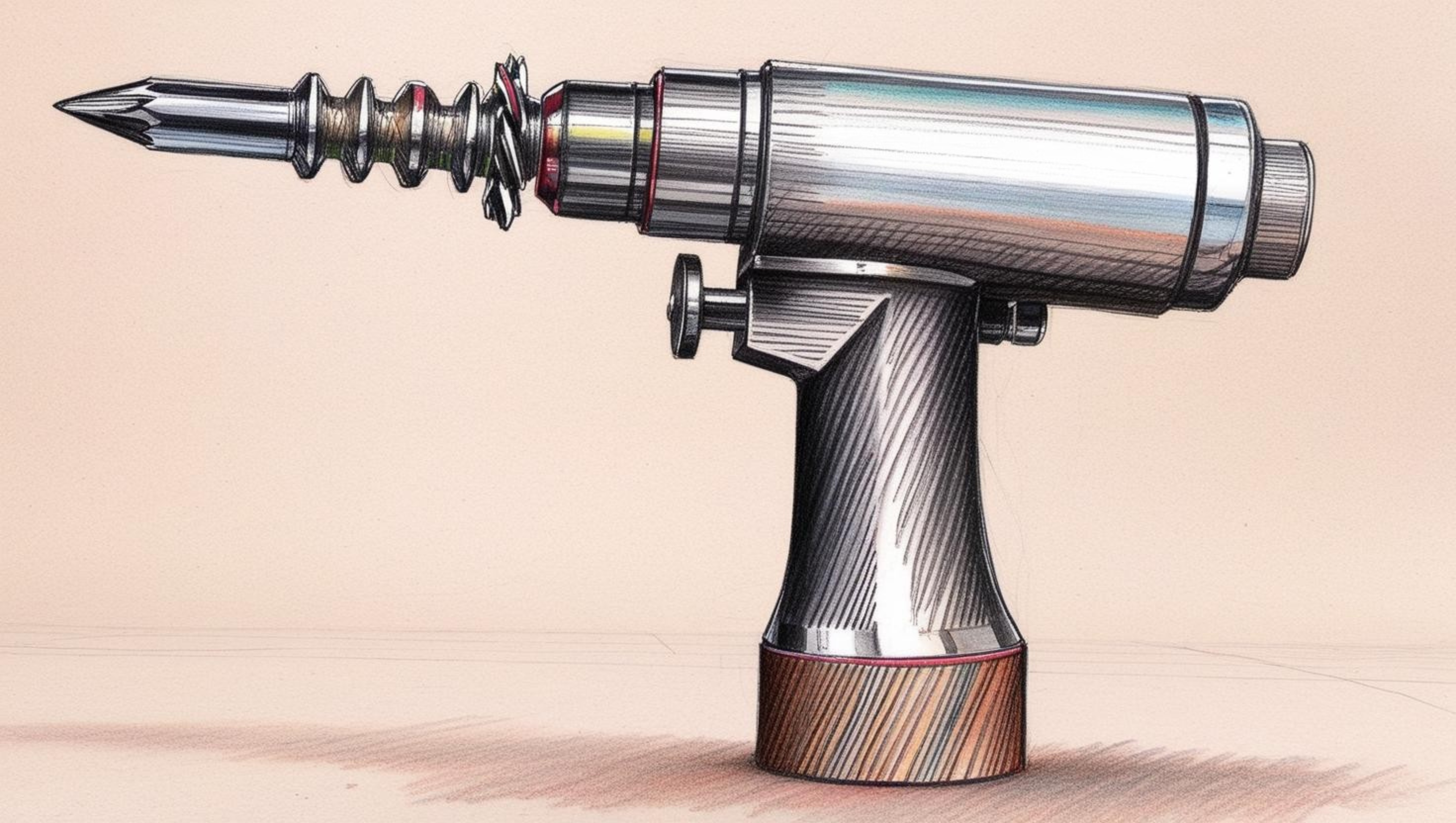
Cranial drill systems, also known as craniotomes, have been used since ancient times, with evidence of trepanning dating back to 4000 B.C. using sharp stones. Modern cranial drills, operating at 40,000 to 80,000 rpm, are critical in neurosurgery for creating burr holes or larger skull openings to relieve brain pressure from trauma or stroke. Advanced models feature smart autostop mechanisms to prevent damage to brain tissue, and some, like the Hubly Drill, allow one-handed operation for faster, safer bedside procedures.
The 13 sections, in brief
Short summaries of each section. The full lessons, images and quizzes are in the Platform.
Overview
A surgeon is drilling into a skull, and the thing they are most afraid of is not the drilling. It is the moment the drilling stops. Bone is about eight millimetres thick at that point. Underneath it is the dura, a tough membrane, and directly under that is the brain and a set of large veins running in channels grooved into the bone itself.
Operations
Follow the power and then follow the safety, because the second one is the device. It starts at a console or a battery. Older systems run on compressed nitrogen from a cylinder or wall supply. Modern ones are electric, either from a console or from a battery in the handpiece.
Importance
The first argument is about access, and it is simple. The skull is a sealed box, and almost nothing can be done to the brain without opening it. Trauma, tumour, haemorrhage, hydrocephalus, epilepsy surgery, aneurysm clipping, biopsy, electrode placement, pressure monitoring. Every one of them begins with a hole.
Physics
Physics Involved in the Cranial Drill System: Concept 1, High-Speed Rotational Cutting Mechanics and Bone-Tissue Interface Dynamics The cranial drill system is a precision surgical device that converts electrical energy into controlled mechanical rotation to penetrate the skull while preserving underlying neural tissue.
Features
Start here, because it is the reason this device exists as a category rather than as a drill. The skull is a few millimetres of bone. Directly beneath it is the dura, and beneath that the brain and large draining veins sitting in grooves worn into the bone itself.
Applications
The commonest application and the standard route into the skull. Burr holes are made at the corners of the planned opening with a perforator. Dura is stripped away from the inner surface of the bone through those holes with a blunt dissector. The craniotome cuts between them, with its footplate sliding in the space that dissection created.
Physiology
This device interacts with four things, in order, over a few millimetres. Bone, which is living tissue and can be killed by heat. Dura, which is a barrier with vessels running inside it. Venous sinuses, which sit in grooves worn into the bone itself. And the brain, which has no capacity to repair itself.
Safety
Two kinds of failure, and they behave nothing like each other. One happens in a fraction of a second, everybody in the room sees it, and it is dealt with immediately. The other happens over seconds, nobody sees anything at all, and the consequence arrives six weeks later in a different clinic. The first gets all the attention. The second causes more reoperations.
Advancements
Forget release years. This device has a shape that is unusual in this library: one enormous safety idea, then steady refinement, and a long period in which the most important improvements were not to the tool at all. Skulls were opened with hand tools. A brace and bit, a trephine, a gouge. Slow, entirely controlled by feel, and safe in skilled hands because nothing happened faster than the operator allowed.
In Research
Bone dies above roughly forty-seven degrees. Drilling can exceed that easily. Dead bone does not heal and becomes a home for infection. And almost nobody measures bone temperature during surgery. Which is remarkable when you lay it out. There is a known threshold, a known mechanism, a known consequence, an instrument that routinely exceeds it, and no measurement in clinical practice at all.
Logistics
An engineer who understands this device is useful. An engineer who understands that the console is bought once and the burs are bought forever understands what is actually being sold. The capital purchase is a console, a handpiece and a set of attachments. What follows is a permanent consumable stream of perforators, burs and craniotome attachments, plus servicing, plus reprocessing.
Alternatives
An alternative is not a competing product. It is another way of answering the clinical question, and here there are two questions hiding inside one device. And, more usefully, do we need to go through it at all? The second question has changed neurosurgery far more than any improvement to the first one.
Ethical
This is a cheap, simple, mechanical tool. It has no software, no data, no algorithm and no company relationship with the patient. And it raises a harder question than most of the sophisticated devices in this library. The operation this device performs decides whether somebody lives. It costs almost nothing. The skill to use it can be taught in a day for the emergency version.
Previous: Conventional X-ray Machine. Next: Cryotherapy Machine. All 69 devices.
Learn it properly, inside the Platform
22 courses, the 69-device library with 13 sections per device, BMEssentials and BMEssence guides and MedTech AI. Start with a 7-day free trial, no card.
Start the 7-day free trial