
BMEssentia Platform / Device library / Defibrillators and their various types
Device library
Defibrillators and their various types
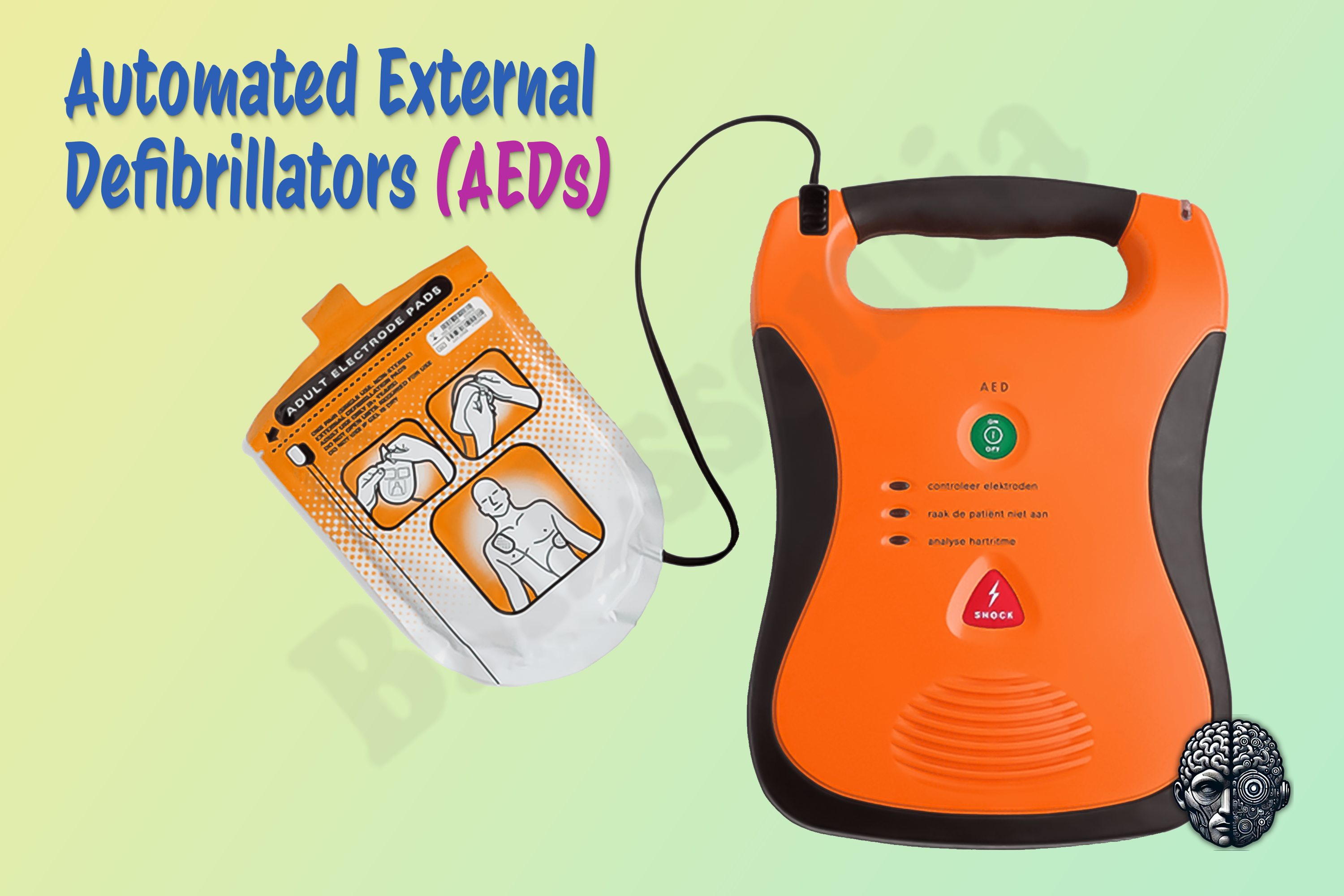
Defibrillators, first used in the 1940s, deliver electric shocks to restore normal heart rhythms during sudden cardiac arrest, saving countless lives. Early models were heavy and hospital-bound, but modern automated external defibrillators (AEDs) are portable, user-friendly, and found in public spaces like airports. Advanced units, like those from ZOLL, use real-time feedback to guide rescuers on compression depth. These devices can increase survival rates by up to 70% when used within minutes of a cardiac event.
The 13 sections, in brief
Short summaries of each section. The full lessons, images and quizzes are in the Platform.
Overview
A man collapses in a shopping centre. Within a minute somebody is pressing on his chest and somebody else has taken a yellow box off the wall. They open it, and a voice starts telling them what to do. They stick two pads on his bare chest, one above his right nipple and one below his left armpit, and the machine says to stand clear. It thinks for about eight seconds.
Operations
Two pads on the chest, current through the heart, and everything else is about deciding when. The pads are positioned so that the current path runs through the heart muscle rather than across the surface of the chest. One below the right collarbone, one on the left side below the armpit. Current takes the path between them, and that path has to include the ventricles.
Importance
The case is unusually simple. Sudden cardiac arrest kills enormous numbers of people, it happens mostly outside hospitals, and in the shockable rhythms it is reversible by a device that costs less than a laptop. That combination does not exist anywhere else in medicine.
Physics
Physics Involved in the Defibrillator Device and its various types: Concept 1, Electrical Discharge and Cardiac Membrane Restoration A defibrillator is one of the most dramatic and vital devices in medicine, a tool that uses controlled bursts of electrical energy to reset the chaotic electrical rhythm of the heart and restore synchronized cardiac contraction.
Features
The capacitor, and why the machine has to charge Start here, because it explains the most recognisable thing about the device. A shock needs a large amount of energy delivered in a few thousandths of a second. A battery cannot do that. Batteries store a lot of energy and release it slowly, through a chemical reaction that takes time.
Applications
The biggest use and the one the public devices exist for. Somebody collapses. No pulse, no breathing, unconscious within seconds. Most of these arrests begin as ventricular fibrillation, frequently caused by a blocked coronary artery starving heart muscle of blood. Starved muscle becomes electrically unstable and the organisation collapses.
Physiology
This device does one thing to living tissue, and understanding it properly explains every rule, every limitation and every misunderstanding in the whole field. It silences an entire organ at once, deliberately, in the hope that the organ's own pacemaker will speak into the silence. Nothing is being started. Something is being stopped, so that the thing underneath can be heard again.
Safety
This device has an unusual safety profile. The patient is already dead. Nothing that happens to them can make their situation worse in the way it could with any other device here. Which means most of the safety in this section is about the people around them, about wasting the only minutes available, and about implanted devices shocking people who are wide awake.
Advancements
Six movements, and the shape is unusual: the machine got smaller and simpler while getting better, and the biggest advances were about who is allowed to use it. Somebody worked out that electricity could stop fibrillation. Early machines were large, used enormous energy, and required the chest to be open.
In Research
This device works. The physics is settled. It is cheap, reliable and usable by anybody. And survival from cardiac arrest outside hospital remains poor in most communities, and has improved far less over decades than anybody expected. Which means the interesting research questions here are mostly not about the machine.
Logistics
Three completely different products sharing one name, and they have almost nothing in common commercially. A public access device is a consumer product sold to schools and offices for a few hundred pounds. A hospital defibrillator is a capital item with a service contract. An implantable device is a high-value implant sold to cardiologists with a registry, a follow-up service and a lawyer attached.
Alternatives
The goal is not to deliver a shock. It is for somebody to survive a cardiac arrest with their brain intact. Which opens this section wider than usual, because the most effective alternatives are not other machines. They are chest compressions, which anybody can do with nothing at all, and preventing the arrest in the first place, which is more effective than everything else combined.
Ethical
Most ethical questions in medicine are decided in a room, with time, by people who can consult each other. This one is decided in about four seconds, by whoever is standing there, about a stranger. Should I touch this person? Should I take their shirt off? Should I start something that might bring them back with a brain that did not survive?
Previous: Cryotherapy Machine. Next: Dermatoscope. All 69 devices.
Learn it properly, inside the Platform
22 courses, the 69-device library with 13 sections per device, BMEssentials and BMEssence guides and MedTech AI. Start with a 7-day free trial, no card.
Start the 7-day free trial