
BMEssentia Platform / Device library / Dual Energy X-ray Absorptiometry (DEXA) Scanner
Device library
Dual Energy X-ray Absorptiometry (DEXA) Scanner
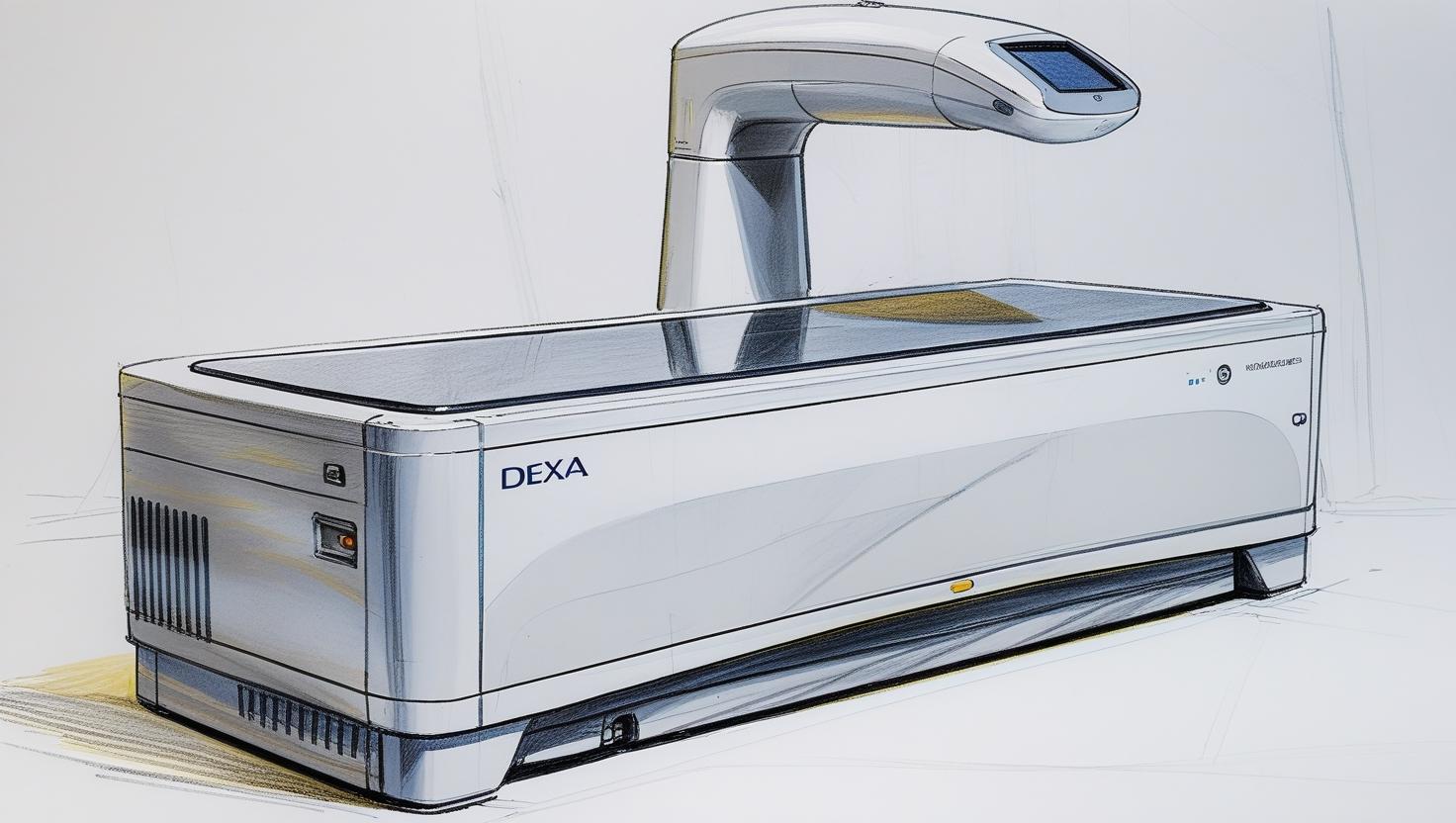
A DEXA scanner measures bone mineral density using two low-dose X-ray beams at different energy levels. It's the most accurate and widely used method to diagnose osteoporosis and assess fracture risk. The scan is quick, painless, and involves very minimal radiation. Surprisingly, DEXA can also analyze body composition, including fat and muscle mass. It's often used in both hospitals and fitness clinics for detailed health assessments.
The 13 sections, in brief
Short summaries of each section. The full lessons, images and quizzes are in the Platform.
Overview
A woman of sixty-eight lies on a padded table for six minutes while a thin arm passes slowly over her hip. She feels nothing. There is no noise, no contrast, no cannula, and the radiation dose is smaller than the amount she absorbs on a transatlantic flight.
Operations
Follow the beam, then follow the analysis, because in this device the analysis is where the errors live. It starts with the X-ray tube beneath the table. It produces a beam at two distinct energy levels, either by rapidly switching the tube voltage or by passing a single beam through a filter that splits it into two energy peaks.
Importance
The first argument is about the scale of what it prevents. Osteoporotic fractures are one of the largest causes of disability in older people, and hip fracture is the most consequential.
Physics
Physics Involved in the Dual-Energy X-ray Absorptiometry (DEXA) Scanner: Concept 1, The Dual-Energy Principle and Tissue Differentiation Every DEXA scanner begins with a single beam of X-rays, yet that beam is not static; it splits its identity into two distinct energy levels, like one photon carrying two perspectives of matter.
Features
Dual energy, and why one energy cannot work Start here, because this is the whole principle. An X-ray beam passing through a hip is attenuated by bone and by the soft tissue around it, and the detector measures only the total. One measurement, two unknowns. Unsolvable.
Applications
Every use of this device is one of four things. Deciding whether to start treatment in somebody with no symptoms. Investigating why somebody's bones are weaker than they should be. Monitoring whether something is working. Or measuring body composition.
Physiology
What bone is made of, how it is continuously rebuilt, why that process fails with age, why the pattern of bone loss differs between sites, and why density is only part of why bones break. A composite material, and the composite nature is the point. A mineral phase, mostly a calcium phosphate crystal, which provides stiffness and resistance to compression.
Safety
The radiation dose is among the lowest of any X-ray examination in medicine, and it is not where the harm is. The harm in this device comes from a number being wrong, and from a number being right and misused. A falsely reassuring result in somebody with osteoporosis, produced by a rotated hip or a calcified aorta, means no treatment and eventually a fractured hip.
Advancements
Forget release years. This device has an unusual shape: the physics was solved early, and the most consequential developments have been a definition, a risk calculator and a service model, none of which is technology. Somebody measured bone mineral using a radioactive source, passing gamma rays through a forearm and measuring the absorption, which established that bone mass could be quantified in a living person.
In Research
A precise measurement of the wrong quantity This device measures areal bone mineral density with excellent reproducibility, and areal density is not what determines whether a bone breaks. Which produces the central unresolved problem of the field: treatments reduce fracture risk by around half while increasing density by only a few percent, and the arithmetic does not close.
Logistics
An engineer who understands this device is useful. An engineer who understands that this is a machine with almost no consumables whose economics depend entirely on throughput understands what is actually being sold. Almost every device in this library makes its money on consumables: cartridges, catheters, electrodes, needles. This one has none.
Alternatives
An alternative is not a competing product. It is another way of answering the clinical question, and here the question is narrower than it appears. The question is not what is this person's bone density. It is whether this person should be treated to prevent a fracture.
Ethical
This device creates a disease in people who feel completely well. A woman walks in with no symptoms and walks out with a diagnosis, a long-term medication and a new understanding of herself as fragile, on the basis of a number that sits below a threshold chosen partly for epidemiological convenience. That is defensible, because the fractures being prevented are devastating and the treatments work.
Previous: Dermatoscope. Next: ECMO machine. All 69 devices.
Learn it properly, inside the Platform
22 courses, the 69-device library with 13 sections per device, BMEssentials and BMEssence guides and MedTech AI. Start with a 7-day free trial, no card.
Start the 7-day free trial