
BMEssentia Platform / Device library / ECMO machine
Device library
ECMO machine
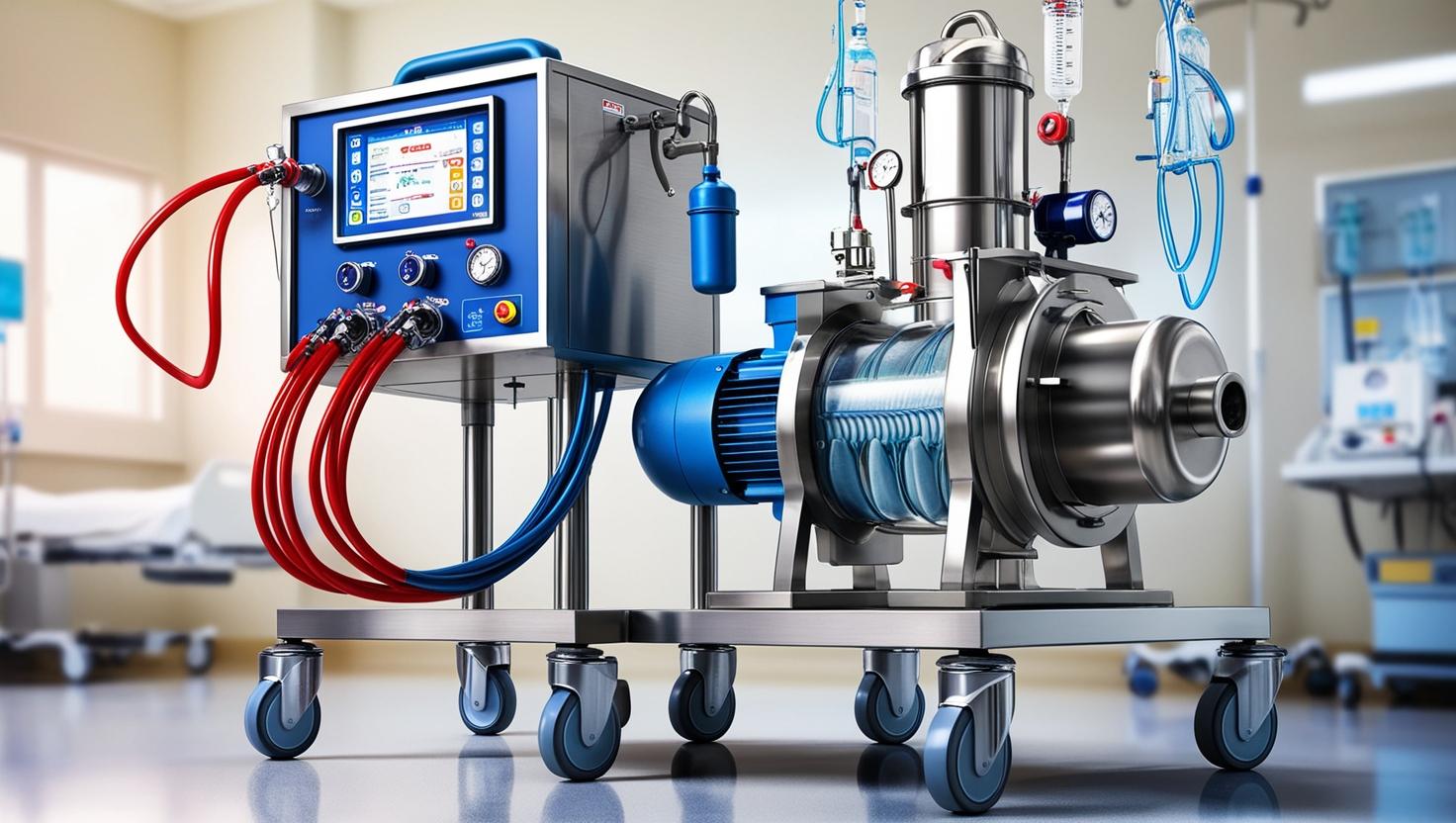
Extracorporeal Membrane Oxygenation (ECMO) machines, first successfully used in 1971, act as a temporary heart and lung substitute for critically ill patients. These complex devices pump and oxygenate blood outside the body, supporting patients with severe heart or lung failure. Modern ECMO systems are portable, allowing use in transport, and can sustain patients for days to weeks. They've saved lives in cases like severe COVID-19, with survival rates for respiratory ECMO reaching up to 60% in specialized centers.
The 13 sections, in brief
Short summaries of each section. The full lessons, images and quizzes are in the Platform.
Overview
A thirty-four-year-old woman is lying in an intensive care bed and she is awake. She can see her family. She has a tablet propped on a pillow.
Operations
There are two configurations and confusing them is the commonest error people make about this machine. Veno-venous support drains blood from a large vein, oxygenates it, and returns it to a vein. The blood then passes through the right heart and out to the body in the normal way, which means the patient's own heart is still doing all the pumping.
Importance
The case for this machine rests on one thing that sounds modest and is not: it converts an unsurvivable few days into a survivable few weeks. Severe lung injury has no cure. The treatment is supportive, and the problem is that the support itself, mechanical ventilation at the pressures required to force gas into stiff lungs, causes further injury to the very organ you are trying to save.
Physics
1. BLOOD FLOW DYNAMICS & PUMP PHYSICS (CENTRIFUGAL VS. At the heart of every ECMO circuit lies its pump, the mechanical engine that keeps blood moving through the extracorporeal loop. Because the patient's heart is partially or entirely bypassed, this pump becomes the artificial driver of systemic circulation, generating flow, maintaining pressure, and ensuring continuous perfusion to vital organs.
Features
The two configurations, and why confusing them is dangerous Before any component, the configuration, because it determines what the machine is actually doing. Blood is drained from a large vein, oxygenated, and returned to a vein. It then travels through the right heart, through the lungs, into the left heart, and out to the body in the normal way.
Applications
This device does not treat anything. It buys time. Which means every indication below is really a bet that something else, an immune response, a drug, a transplant, or simply healing, will arrive before the complications do. When that bet is reasonable, this is among the most valuable machines in medicine. When it is not, it prolongs a death.
Physiology
Every other device in this library measures physiology or acts on it. This one joins it. A second circulation is plumbed into the patient's own, in parallel, running continuously for weeks, and the two systems interact in ways that are frequently counterintuitive and occasionally dangerous.
Safety
Bypass has one governing safety sentence: if the machine stops, the patient has no circulation. The machine must run continuously for weeks, in an intensive care unit, watched by a nurse with many other responsibilities, on a patient who is anticoagulated, who will be turned, transported, dialysed and possibly walked, and every single one of those events can kill them.
Advancements
Forget release years. The shape predicts direction, and this device has the strangest shape in the library: it worked, was abandoned as a failure, and came back. Bypass was extended past its intended duration in a few desperate cases, which is where the idea came from. No new invention, just somebody refusing to disconnect.
In Research
This therapy is used worldwide, in specialist centres, on patients who would otherwise die, at enormous cost. And essentially every important question about how to run it is open. Nobody agrees which anticoagulant to use, which test to monitor it with, or what target to aim for. Practice varies between centres, between patients, and sometimes between shifts in the same unit.
Logistics
An engineer who understands how this circuit works is useful. An engineer who understands that a unit can own the machine, the circuits and the cannulas and still be unable to run the therapy understands what is actually being sold. Because the binding constraint here is not equipment. It is a trained team available at three in the morning, and no amount of hardware substitutes for it.
Alternatives
An alternative is not a competing product. It is another way of achieving the clinical goal, and the goal here is not to support an organ. It is to keep a patient alive until something reversible reverses. Which makes this section unusual, because the most important alternative is not a machine.
Ethical
Every other device in this library raises ethical questions about how it is used. This one raises a question about what it means to be alive, and it raises it in a specific and practical way, in an intensive care unit, with a family in the corridor. A supported patient has no heartbeat generating their circulation and no breathing producing their gas exchange.
Previous: Dual Energy X-ray Absorptiometry (DEXA) Scanner. Next: EEG (Electroencephalogram) Machine. All 69 devices.
Learn it properly, inside the Platform
22 courses, the 69-device library with 13 sections per device, BMEssentials and BMEssence guides and MedTech AI. Start with a 7-day free trial, no card.
Start the 7-day free trial