
BMEssentia Platform / Device library / EEG (Electroencephalogram) Machine
Device library
EEG (Electroencephalogram) Machine
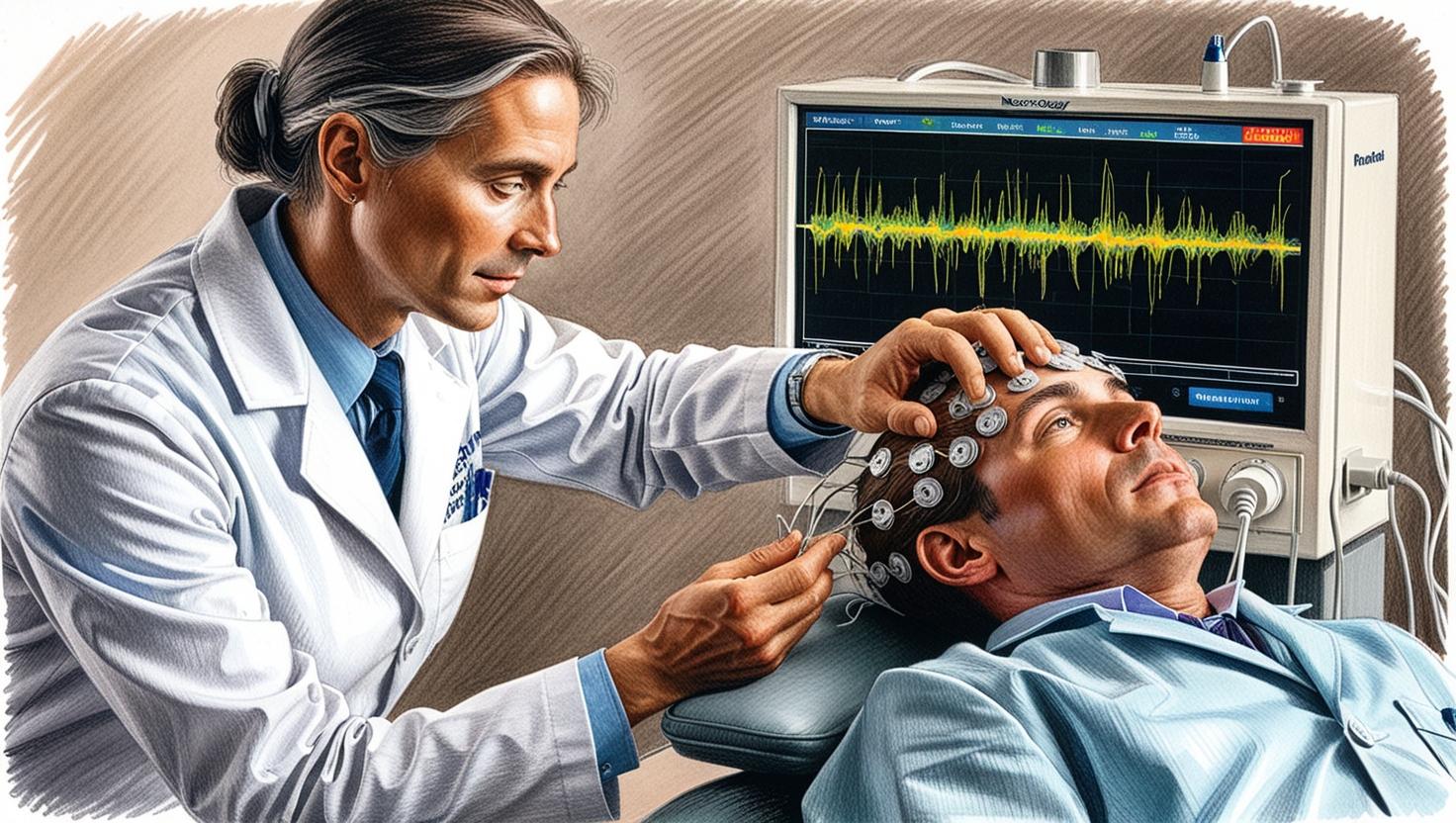
The electroencephalogram (EEG) machine, first used on humans in 1924 by Hans Berger, records brain electrical activity through scalp electrodes, detecting signals as small as 10 microvolts. Initially bulky, modern EEGs are portable, with wireless caps enabling real-time monitoring during sleep or seizures. They're vital for diagnosing epilepsy, sleep disorders, and brain injuries. Advanced systems now use AI to analyze patterns, improving detection of conditions like Alzheimer's, with some setups allowing home monitoring for greater patient comfort.
The 13 sections, in brief
Short summaries of each section. The full lessons, images and quizzes are in the Platform.
Overview
A child of seven is lying on a bed with twenty-one small discs glued to her scalp. She has been having episodes where she stops, stares, and does not respond for about eight seconds, sometimes thirty times a day. Her teacher thinks she is daydreaming. Her parents think she is ignoring them.
Operations
Follow the signal from the neuron to the report, and then follow what the technologist does to provoke it. It starts in the cortex. Pyramidal cells receive synaptic input, which creates small currents flowing along their length. Because these cells are aligned perpendicular to the cortical surface, their individual fields sum.
Importance
The first argument is about a diagnosis that nothing else can make. Epilepsy is a clinical diagnosis supported by the EEG, and in several syndromes the EEG is definitive. The generalised spike-and-wave pattern of absence epilepsy. The characteristic discharges of juvenile myoclonic epilepsy. The chaotic high-amplitude pattern of infantile spasms.
Physics
Concept 1, Fundamental Architecture and Electrode Physics of the EEG System An electroencephalogram (EEG) system is the only device in biomedical engineering that reads the electrical symphony of the human brain in real time, a technology that translates ionic thought into electronic signal.
Features
Start here, because it explains what the device can and cannot see. Cortical pyramidal neurons are arranged perpendicular to the cortical surface, all oriented the same way, in dense parallel arrays. Which means the small electrical fields produced by each one point in the same direction and add together.
Applications
Every use of this device is one of four things. Classifying a seizure disorder. Finding electrical activity nobody can see. Assessing how well a brain is working. Or locating something precisely enough to operate on it. The core application, and the emphasis on classification rather than diagnosis is deliberate.
Physiology
Why only some neurons produce a measurable signal, why the skull ruins it, why the brain has rhythms at all, what a seizure actually is, and why the recording changes completely when somebody falls asleep. The anatomical accident that makes EEG possible.
Safety
A scalp EEG is among the physically safest procedures in this library, and this device has one of the worst harm profiles in it. The harm is diagnostic. A normal variant reported as epileptiform produces a person who takes anticonvulsants for a decade, loses their driving licence, is refused employment, and reorganises their life around a condition they never had. That is not a rare adverse event.
Advancements
Forget release years. This device has a distinctive shape: the measurement was established early and has barely changed, and every advance has been about recording for longer, seeing the patient at the same time, or getting under the skull. Somebody recorded electrical activity from a human scalp and demonstrated that the brain produces rhythms that change with state, which was doubted for years.
In Research
A test whose central problem is the reader Most devices in this library have a measurement problem. This one does not. The signal has been recorded reliably for the better part of a century, and the unresolved problem is that two qualified people looking at the same recording frequently disagree about whether it is abnormal.
Logistics
An engineer who understands this device is useful. An engineer who understands that this is a modestly priced machine attached to two of the scarcest skills in clinical medicine understands what is actually being sold. An EEG system costs a fraction of any imaging device in this library.
Alternatives
An alternative is not a competing product. It is another way of answering the clinical question, and here the division is unusually clean. For structure, everything else is better. For function in real time, almost nothing competes at all. The most important entry and the one most consistently undervalued.
Ethical
This device attaches a label to a person, and the label is one of the most consequential in medicine. A diagnosis of epilepsy changes what somebody is allowed to do, what work they can hold, whether they can drive, what insurance costs them, how they are treated socially, and in many parts of the world whether they can marry.
Previous: ECMO machine. Next: Electrocardiogram (ECG or EKG) Machine. All 69 devices.
Learn it properly, inside the Platform
22 courses, the 69-device library with 13 sections per device, BMEssentials and BMEssence guides and MedTech AI. Start with a 7-day free trial, no card.
Start the 7-day free trial