
BMEssentia Platform / Device library / Electrosurgical Unit
Device library
Electrosurgical Unit
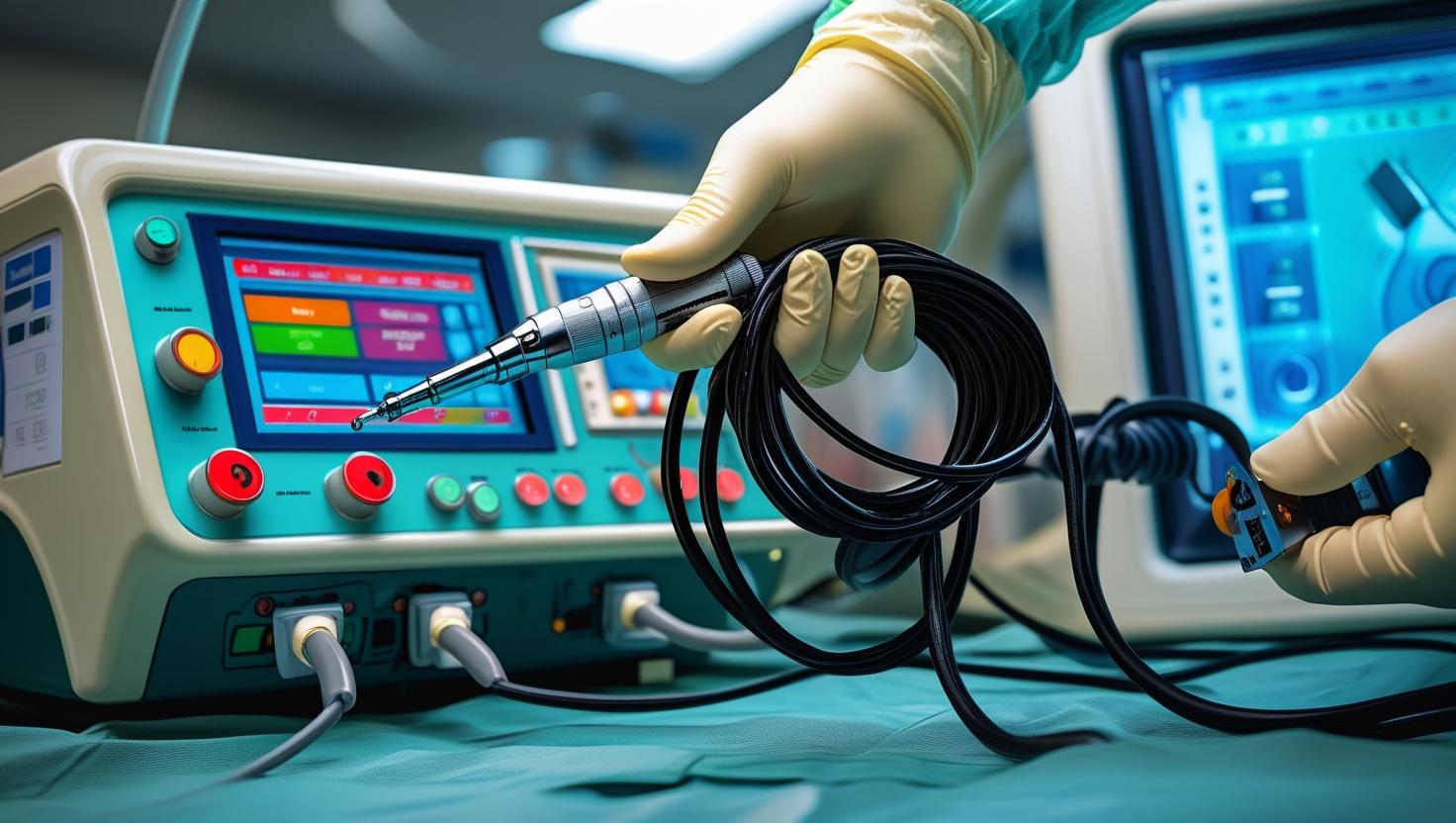
Electrosurgical units (ESUs), used since the 1920s, revolutionized surgery by using high-frequency electrical currents to cut tissue and control bleeding with precision. Invented by Dr. William Bovie, early ESUs were bulky spark-gap devices. Today's compact units deliver controlled energy for cutting, coagulating, or ablating tissue, minimizing blood loss. Advanced ESUs feature safety systems like tissue impedance monitoring to prevent burns and can be used in minimally invasive procedures, enhancing surgical outcomes across specialties.
The 13 sections, in brief
Short summaries of each section. The full lessons, images and quizzes are in the Platform.
Overview
A surgeon draws a thin pen-shaped instrument across a patient's abdomen. There is a faint buzzing tone, a hiss, and a thread of grey smoke. The skin and the fat beneath it part as if the pen were a blade, and almost nothing bleeds. The tip of that pen is cool to the touch a second before it is used. The heat is not coming from the instrument.
Operations
Follow the current out of the generator, through the patient, and back. It starts with the generator. When switched on, it runs a self-check. Staff choose a mode, cut, coagulation or blend, and a power setting, measured in watts. Then the return electrode is applied.
Importance
The first argument is about bleeding, which has always been the main enemy of surgery. Before reliable ways to control bleeding, every cut into the body was a race. Surgeons had to tie off each vessel by hand, and oozing from countless small vessels filled the wound and hid what they were doing.
Physics
Physics Involved in the Electrosurgical unit Device: Concept 1, Generation and Control of High-Frequency Electrical Energy in the Electrosurgical Unit The heart of every electrosurgical unit is a power-conversion system that takes ordinary mains electricity, 230 V AC at 50 to 60 Hz, and transforms it into a controlled, high-frequency oscillation ranging from 300 kHz to 4 MHz.
Features
Start here, because this is what makes electrosurgery possible at all. Electric current at low frequencies, like mains electricity, stimulates nerves and muscles. It causes painful shocks, violent muscle contractions and can stop the heart. Electrosurgical units use alternating current at radio frequencies, typically hundreds of thousands of cycles per second.
Applications
Every use of this device is one of four things. Cutting tissue. Stopping bleeding. Sealing vessels. Or destroying tissue that should not be there. Almost every surgical specialty uses all four, often in the same operation. Opening the abdomen, dividing tissue, controlling bleeding, and removing organs such as the gallbladder, bowel and appendix.
Physiology
How the body conducts electricity, why nerves ignore fast current, what heat does to tissue, how blood vessels are sealed, why burns can appear days later, and how implanted devices hear electrical noise. Start here, because the patient is part of the circuit.
Safety
This device is safe when the current goes only where it should, and dangerous whenever it does not. Almost every serious electrosurgical injury happens away from the surgeon's view: under the pad, along an instrument shaft, in a narrow body part, at a monitoring electrode, inside an implanted device or in a fire starting under the drapes. The surgeon's attention is on the tip. The dangers are everywhere else.
Advancements
Forget release years. This device has a clear shape: it began with heat pressed onto the body from outside, discovered how to make heat inside the body instead, and has spent the rest of its history learning, often painfully, where the current goes after it leaves the tip.
In Research
The most used energy device in surgery, and one of the least measured This device is switched on in most operations performed today. And for a device used so often, remarkably little is known about how it is actually used in ordinary theatres: what settings are chosen, how long it is activated, how many instruments leak, how much smoke staff breathe, and how many injuries are never linked back to it.
Logistics
An engineer who understands this device is useful. An engineer who understands that the generator is the cheap part and the instruments plugged into it are where the money is understands what is actually being sold. A basic electrosurgical generator is a durable piece of equipment that lasts many years.
Alternatives
An alternative is not a competing product. It is another way of answering the surgical question, and here the question is really three questions. How do I divide this tissue? How do I stop this bleeding? And how do I do both without harming anything I cannot see?
Ethical
This device is used on almost every surgical patient, and almost none of them know it. Patients consent to an operation, not to an electrical current passing through their body, and most are never told that it will happen, what it can cause, or that a sticky pad on their thigh is part of their surgery. That is usually reasonable, because the risks are small and the benefits large.
Previous: Electrophysiology Mapping System. Next: EMG (Electromyography) Machine. All 69 devices.
Learn it properly, inside the Platform
22 courses, the 69-device library with 13 sections per device, BMEssentials and BMEssence guides and MedTech AI. Start with a 7-day free trial, no card.
Start the 7-day free trial