
BMEssentia Platform / Device library / Endoscopes
Device library
Endoscopes
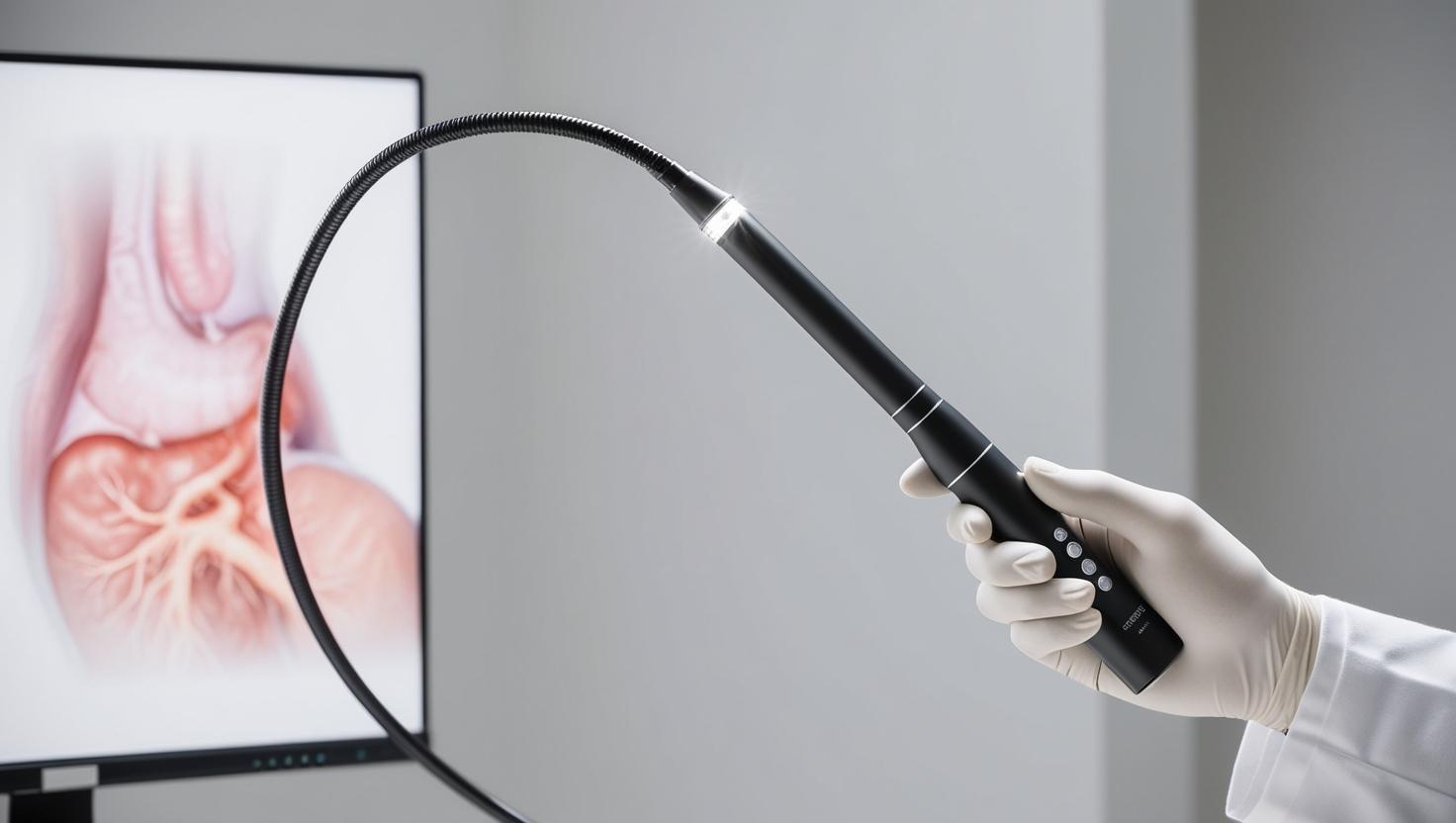
Endoscopes, first developed in the early 1800s, revolutionized medicine by allowing doctors to see inside the body without major surgery. The earliest models used candles and mirrors for light, but today's endoscopes use fiber optics and high-definition cameras for crystal-clear images. Modern versions can navigate the digestive tract, lungs, or joints, and some even have tools for biopsies or small repairs. This technology has made diagnostics and treatments less invasive, improving patient outcomes.
The 13 sections, in brief
Short summaries of each section. The full lessons, images and quizzes are in the Platform.
Overview
A woman is lying on her side in a room with the lights dimmed, and somebody is about to push a metre of flexible tubing down her throat. She is sedated but not asleep. She can feel it going in.
Operations
Follow the light, then follow the channel, then follow the instrument coming back out. It starts at a light source, a bright lamp or LED array in a box beside the patient. Light travels down the scope through bundles of glass fibres, thousands of them, each carrying light along its length by total internal reflection.
Importance
The first argument is the one that changed medicine and it is easy to understate. Before flexible endoscopy, finding out what was wrong inside the gastrointestinal tract meant either indirect imaging that showed shadows rather than tissue, or opening the abdomen and looking.
Physics
Physics Involved in the Endoscope Device: Concept 1, Optical Architecture and Visualization Core of the Endoscope An endoscope is not merely a camera; it is a precision optical instrument that folds an entire imaging laboratory into a few millimeters of glass and steel.
Features
The insertion tube, and why it is built in layers Start with the body of the scope, because its construction is a set of competing demands solved by stacking materials. Bend around tight corners, because the colon turns back on itself and the duodenum is a horseshoe.
Applications
The commonest procedure and the most routine. Persistent indigestion, difficulty swallowing, unexplained weight loss, anaemia, vomiting blood. The scope passes through the mouth, down the oesophagus, into the stomach, and into the first part of the duodenum. Ulcers, inflammation, narrowings and tumours are seen directly and sampled in the same visit.
Physiology
What the device does to the body: it distends hollow organs with gas, stretches structures that were never meant to be stretched, and passes a tube through a reflex-protected airway. And what the body does to the device: it resists at every corner, it coats the lens, and it fills the channels with the material that will later have to be cleaned out of them.
Safety
Two categories, and they are separated by where the harm comes from. The procedural risks belong to the patient on the table and they are visible within hours. The reprocessing risks belong to the next patient, and to the one after that, and they appear weeks later in somebody who was never told which instrument was used on them. The first category is well understood and consented for.
Advancements
Forget release years. This device has a clear shape: it became steerable, then it became a treatment instrument, then it became a camera everybody could see, and then it ran into a problem it has not solved. Rigid tubes with external light. Painful, dangerous, limited to what was straight ahead, and they established that you could look inside a living person at all.
In Research
Two endoscopists, the same unit, the same scopes, the same screening population. One finds an adenoma in a quarter of patients. The other finds one in a half. And the patients examined by the first one develop colorectal cancer at a measurably higher rate over the following years.
Logistics
An engineer who understands this device is useful. An engineer who understands that an endoscopy unit is two rooms, and the one without patients in it determines the capacity of the one with patients in it, understands what is actually being bought.
Alternatives
An alternative is not a competing product. It is another way of answering the clinical question, and here the question splits cleanly in two. If you only need to look, several things compete and some of them are better. If you need to take tissue or treat something, almost nothing competes at all.
Ethical
Most devices in this library carry risks that belong to the person being treated. This one carries a risk that belongs to somebody else. When an endoscope transmits an organism, the person harmed is not the patient whose procedure introduced it.
Previous: EMG (Electromyography) Machine. Next: Esophageal Manometry System. All 69 devices.
Learn it properly, inside the Platform
22 courses, the 69-device library with 13 sections per device, BMEssentials and BMEssence guides and MedTech AI. Start with a 7-day free trial, no card.
Start the 7-day free trial