
BMEssentia Platform / Device library / Fetal Monitor
Device library
Fetal Monitor
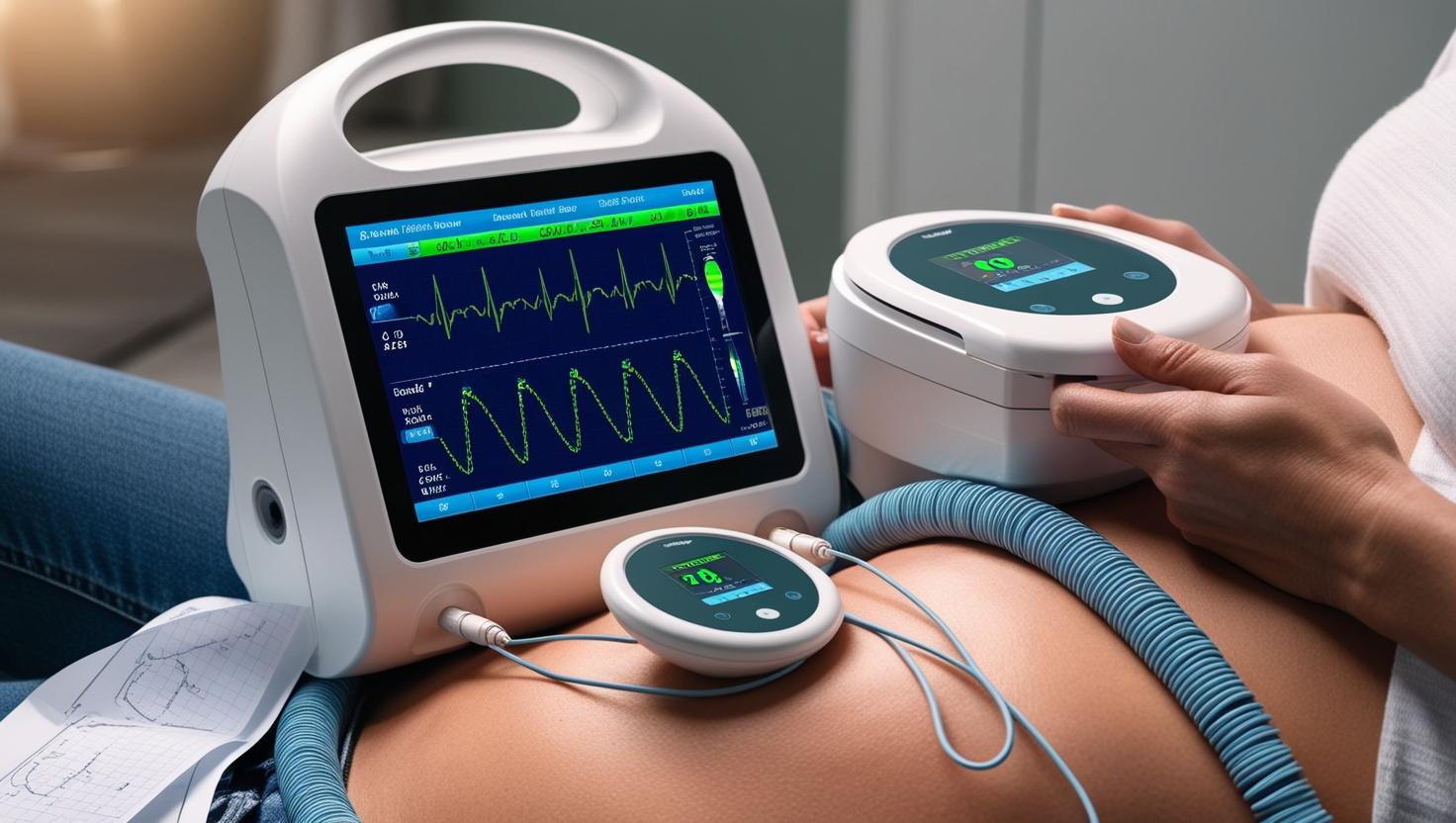
Fetal monitors, introduced in the 1960s, revolutionized childbirth by allowing doctors to track a baby's heart rate and uterine contractions in real-time. Early models used basic microphones, but today's devices employ Doppler ultrasound for non-invasive monitoring, detecting heart rates as low as 50 beats per minute. Advanced fetal monitors can transmit data wirelessly to hospital systems, enabling continuous monitoring during labor. They've significantly reduced infant mortality by identifying distress early, saving countless lives.
The 13 sections, in brief
Short summaries of each section. The full lessons, images and quizzes are in the Platform.
Overview
It is ten past four in the morning on a labour ward. A woman having her first baby has been in labour for eleven hours. Two elastic belts are wrapped around her abdomen, and from a machine beside the bed a strip of paper is slowly scrolling out, with two lines drawn on it.
Operations
Follow the signal from the baby's heart to the line on the paper. It starts with positioning. The midwife feels the abdomen to find the baby's back, because the heart is heard best through it. A Doppler transducer is placed there with gel and held in place by an elastic belt.
Importance
The first argument is about the most dangerous journey most people ever make. Labour exposes the fetus to repeated interruptions of its oxygen supply. Every contraction squeezes the blood vessels in the uterine wall and briefly reduces blood flow to the placenta. A healthy baby with a healthy placenta tolerates this easily, hundreds of times.
Physics
Physics Involved in the Fetal monitor Device: Concept 1, Real-Time Hemodynamic Sensing and Biophysical Synchronization The fetal monitor is a precision system built to measure, in real time, the interaction between two circulatory systems-the maternal and the fetal.
Features
Start here, because this is how most fetal heart rates are measured. A disc of piezoelectric crystals sends a continuous or pulsed ultrasound beam into the abdomen. Anything moving in the beam changes the frequency of the returning echo. Moving toward the transducer raises it. Moving away lowers it.
Applications
Every use of this device is one of four things. Watching a baby through labour. Checking a baby before labour. Catching an emergency the moment it happens. Or deciding that a baby can safely stay where it is. The last one is the most underrated, and it is where the device is most trustworthy.
Physiology
How a fetus breathes through a placenta, why a fetus survives on so little oxygen, what a contraction does to the oxygen supply, how the fetal brain controls the heart, how a fetus defends itself against hypoxia, and what happens when the defences run out.
Safety
The physical risks of this device are small. The risks created by reading it are large, and they fall in both directions. Miss a real problem and a baby can die or be left with lifelong brain injury. Over-call a false one and a mother has major abdominal surgery she did not need. Both errors happen every day, somewhere, and the device itself cannot prevent either.
Advancements
Forget release years. This device has a shape found almost nowhere else in medicine: it became universal before anybody proved it worked, and when the proof arrived it was smaller than expected, and practice could not go back. Somebody put an ear to a pregnant abdomen and established that the fetal heart could be heard, and that a slow heart during labour was a bad sign.
In Research
A universal device with a disputed benefit This device monitors a large share of all births in high-income countries, and the central question about it is still open. Nobody knows how to use the tracing so that it prevents injury without causing unnecessary surgery, and every attempt to improve the measurement has left that question largely where it was.
Logistics
An engineer who understands this device is useful. An engineer who understands that the most expensive component of a fetal monitoring service is the record it produces understands what is actually being bought. The monitor at the bedside is a moderate purchase, and hospitals tend to think about it as the product.
Alternatives
An alternative is not a competing product. It is another way of answering the clinical question, and here the question changes depending on when it is asked. In labour, the question is whether the baby is coping, and whether it needs to be delivered now.
Ethical
This device monitors two patients at once, and only one of them can speak. Every decision in this device sits between a woman, who has full rights over her own body, and a baby, whose wellbeing depends on what happens to that body. Usually their interests point the same way.
Previous: Extracorporeal Shock Wave Lithotripter. Next: Glucometer. All 69 devices.
Learn it properly, inside the Platform
22 courses, the 69-device library with 13 sections per device, BMEssentials and BMEssence guides and MedTech AI. Start with a 7-day free trial, no card.
Start the 7-day free trial