
BMEssentia Platform / Device library / Hemodialysis Machine and peritoneal dialysis machine
Device library
Hemodialysis Machine and peritoneal dialysis machine
Hemodialysis machines, used since the 1940s, filter blood through an artificial kidney (dialyzer) to remove toxins and fluid, typically requiring 3-4 hour sessions three times a week. Peritoneal dialysis machines, or cyclers, introduced in the 1970s, use the abdominal lining as a natural filter, allowing daily home treatments with automated overnight exchanges. Modern hemodialysis systems, like the Tablo, integrate water purification for home use, while advanced cyclers, such as Baxter's Amia, offer voice-guided instructions and remote monitoring, enhancing patient independence and flexibility.
The 13 sections, in brief
Short summaries of each section. The full lessons, images and quizzes are in the Platform.
Overview
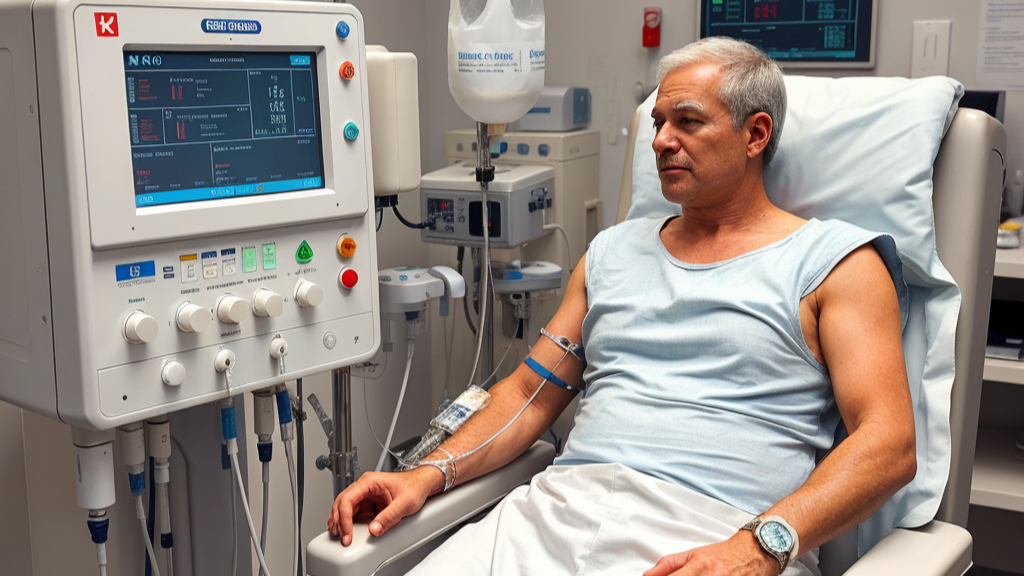
A man sits in a chair on a Tuesday morning with two needles in his forearm. Blood is leaving his body at around three hundred millilitres a minute, travelling down a plastic line into a plastic cartridge about the size of a rolling pin, and coming back into the same arm a metre away. He will sit there for four hours.
Operations
Follow the blood. It leaves the patient and comes back, and every component between those two points exists for a reason you can trace. It starts at the access, which is where a great deal of this therapy's real difficulty lives. You need to take blood out of somebody at around three hundred millilitres a minute and put it back. No normal vein carries that. A vein punctured at that rate collapses and scars.
Importance
This device is one of a very small number in medicine that replaced a disease with a condition. Before it existed, kidney failure was uniformly fatal. Not usually, not mostly. Uniformly. A person whose kidneys stopped accumulated potassium until their heart stopped, or accumulated fluid until they drowned in it, or accumulated waste until they became confused, then comatose, then died.
Physics
Physics Involved in the Hemodialysis machine: Concept 1, Mass Transfer and Solute Kinetics in the Dialyzer Inside the hemodialysis machine lies its beating core, the dialyzer, a cylindrical micro-architecture containing thousands of hollow fibers, each thinner than a strand of hair yet carrying the power to rewrite the chemistry of blood.
Features
The membrane, and what a pore size actually decides Start here, because it is the device and everything else serves it. Let small waste molecules through. Let water through when pushed. Keep every protein and every blood cell on the blood side. And do all of that while blood is flowing over it for four hours without clotting on it.
Applications
The largest application and the one most people picture. Kidney function declines over years, usually from diabetes or hypertension, occasionally from inherited disease or inflammation, and at some point it falls below the level that sustains life. And the decision about when to start is less obvious than it looks.
Physiology
What a kidney actually does, so you can see what is missing Six jobs, and the machine does one and a half of them. Filtration and selective reabsorption. An enormous volume is filtered and almost all of it reclaimed, with precise control over what stays and what goes.
Safety
This device has a safety profile unlike almost anything else in the library, and the reason is exposure. A patient meets this machine twelve hours a week for years. Which means a hazard with a one in ten thousand chance per session becomes a near certainty across a treatment lifetime, and a low-level harm repeated three times a week becomes the thing that kills them.
Advancements
Forget release years. This device has a shape, and the shape is unusual: the core idea was correct immediately and the problem was never the physics. It was access, water and money. Somebody showed that solutes cross a membrane out of blood. The principle worked on the first attempt, on animals, with crude materials, and it has never been improved on because it is physics rather than engineering.
In Research
Dialysis has kept millions of people alive for sixty years. And almost nothing about how it should be delivered has been settled by a trial. The large trial that tested giving more dialysis showed no survival benefit, which nobody expected and which the field has never fully absorbed. The trial that tested correcting anaemia fully showed harm. The trial that tested starting earlier showed no benefit.
Logistics
An engineer who understands this machine is useful. An engineer who understands that the machine is the cheap part, the water plant is the expensive part, and the dialyser is the business understands what is actually being sold. Because this is the most extreme razor-and-blade structure in the entire library, and the numbers make it obvious.
Alternatives
An alternative is not a competing product. It is another way of answering the clinical question, and here the question is not "how do we clean blood." It is: this person's kidneys have failed. What happens now, for the rest of their life? Which makes this the only section in the library where one of the alternatives is an organ, and another is choosing not to treat.
Ethical
Most devices in this library raise ethical questions. This one produced an academic discipline. When dialysis first worked and there were more patients than machines, hospitals had to decide who would receive it. A committee was convened in one of them: a lawyer, a minister, a banker, a housewife, a labour leader, a surgeon, a government official.
Previous: Glucometer. Next: Holter Monitor. All 69 devices.
Learn it properly, inside the Platform
22 courses, the 69-device library with 13 sections per device, BMEssentials and BMEssence guides and MedTech AI. Start with a 7-day free trial, no card.
Start the 7-day free trial