
BMEssentia Platform / Device library / Holter Monitor
Device library
Holter Monitor
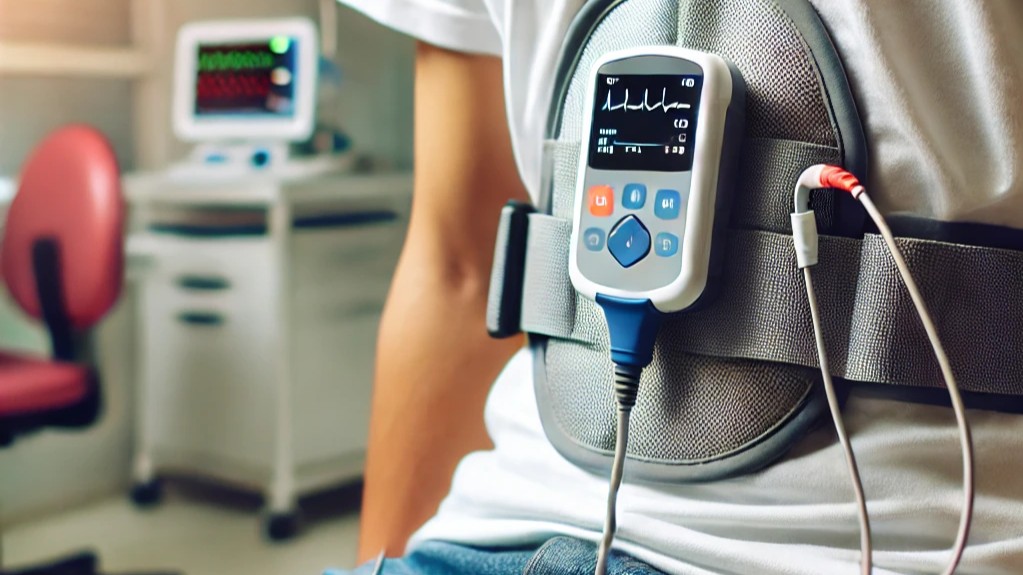
The Holter monitor is a portable, wearable device that continuously records a patient's heart rhythm for 24 to 48 hours through electrodes attached to the chest. It detects irregular heartbeats, arrhythmias, and silent cardiac events that may be missed during a standard ECG. Modern versions use digital technology with enhanced storage capacity, allowing extended monitoring periods up to 14 days. Some advanced models now include Bluetooth connectivity for real-time data transmission and automatic event detection algorithms. This non-invasive tool remains essential for diagnosing conditions like atrial fibrillation, palpitations, and unexplained syncope. Lightweight designs and waterproof.
The 13 sections, in brief
Short summaries of each section. The full lessons, images and quizzes are in the Platform.
Overview
A woman of sixty-one has been blacking out. Twice in four months, both times without warning, both times waking up on the floor. She has had an ECG in clinic. It was normal. She has had an echocardiogram. It was normal. She has had blood tests, a tilt table test and a neurology opinion, and all of them were normal.
Operations
Follow the recording from the skin to the report, and then follow the part that is done by the patient. It starts with the electrodes. Usually five, sometimes seven, placed on the torso rather than on the limbs. Limb positions are useless in an ambulatory recording because arm and leg movement produces overwhelming artefact, so the electrodes are moved onto the chest wall where they are relatively stable.
Importance
The first argument is about a specific clinical question that nothing else answers. Does this person's symptom correspond to an arrhythmia? Palpitations, dizziness, blackouts. All common, all frequently benign, and all occasionally the first sign of something that will kill somebody.
Physics
Physics Involved in the Holter monitor Device: Concept 1, Continuous Ambulatory Cardiac Monitoring Architecture and Long-Duration Bioelectrical Data Acquisition in Holter Systems The Holter monitor is the embodiment of endurance in biomedical instrumentation, a device built not for a momentary snapshot of the heart but for the complete chronicle of its behavior across hours, sometimes days.
Features
Electrodes and why they move to the torso Start here, because this is where the recording succeeds or fails. A standard ECG puts electrodes on the wrists and ankles, and that is fine in somebody lying still for ten seconds. In an ambulatory recording, every arm movement produces muscle activity and skin stretch directly under the electrode, which swamps a signal measured in millivolts.
Applications
Every use of this device is one of four things. Connecting a symptom to a rhythm. Finding something the patient cannot feel. Counting how much of something there is. Or checking that a treatment is working. The first is what the device was invented for and the third is where it quietly earns its keep.
Physiology
Why the heart rate changes constantly, what is normal during sleep, why arrhythmias are intermittent at all, and why a symptom and a rhythm have to be matched rather than assumed. The physiology that makes a day of recording informative rather than repetitive.
Safety
This device cannot injure anybody physically, and it has a safety profile that is entirely about false conclusions. The harms are a normal recording used to reassure somebody who is not safe, artefact reported as arrhythmia leading to an implanted device, incidental findings treated in people who were well, and a patient sent home with a recorder when they needed somebody watching them.
Advancements
Forget release years. This device has one of the clearest shapes in the library: every meaningful advance has been an increase in how long the recording lasts, and everything else has been packaging. Somebody built a wearable cardiac recorder that transmitted from a backpack weighing more than the patient wanted to carry. It proved that a heart could be recorded during ordinary life.
In Research
The diagnostic yield of this device depends almost entirely on one variable, which is whether the recording duration matches the symptom frequency. And almost no department measures whether it is getting that right.
Logistics
An engineer who understands this device is useful. An engineer who understands that the analysis costs more than the recorder and the recorder is not the bottleneck understands what is actually being sold. A Holter recorder is cheap and lasts years. The constraint on a service is the technician time required to over-read each recording, which is hours per study and which scales directly with recording length.
Alternatives
An alternative is not a competing product. It is another way of answering the clinical question, and this device is unusual because most of its alternatives are itself at a different duration. The question is almost never which technology. It is how long, and whether anybody needs to be watching.
Ethical
This device produces a document that says no significant arrhythmia, in a patient who has a significant arrhythmia. And that sentence is not a lie, not an error, and not a malfunction. It is a true statement about twenty-four hours, read as a statement about a person.
Previous: Hemodialysis Machine and peritoneal dialysis machine. Next: Hyperthermia Treatment System. All 69 devices.
Learn it properly, inside the Platform
22 courses, the 69-device library with 13 sections per device, BMEssentials and BMEssence guides and MedTech AI. Start with a 7-day free trial, no card.
Start the 7-day free trial