
BMEssentia Platform / Device library / Hyperthermia Treatment System
Device library
Hyperthermia Treatment System
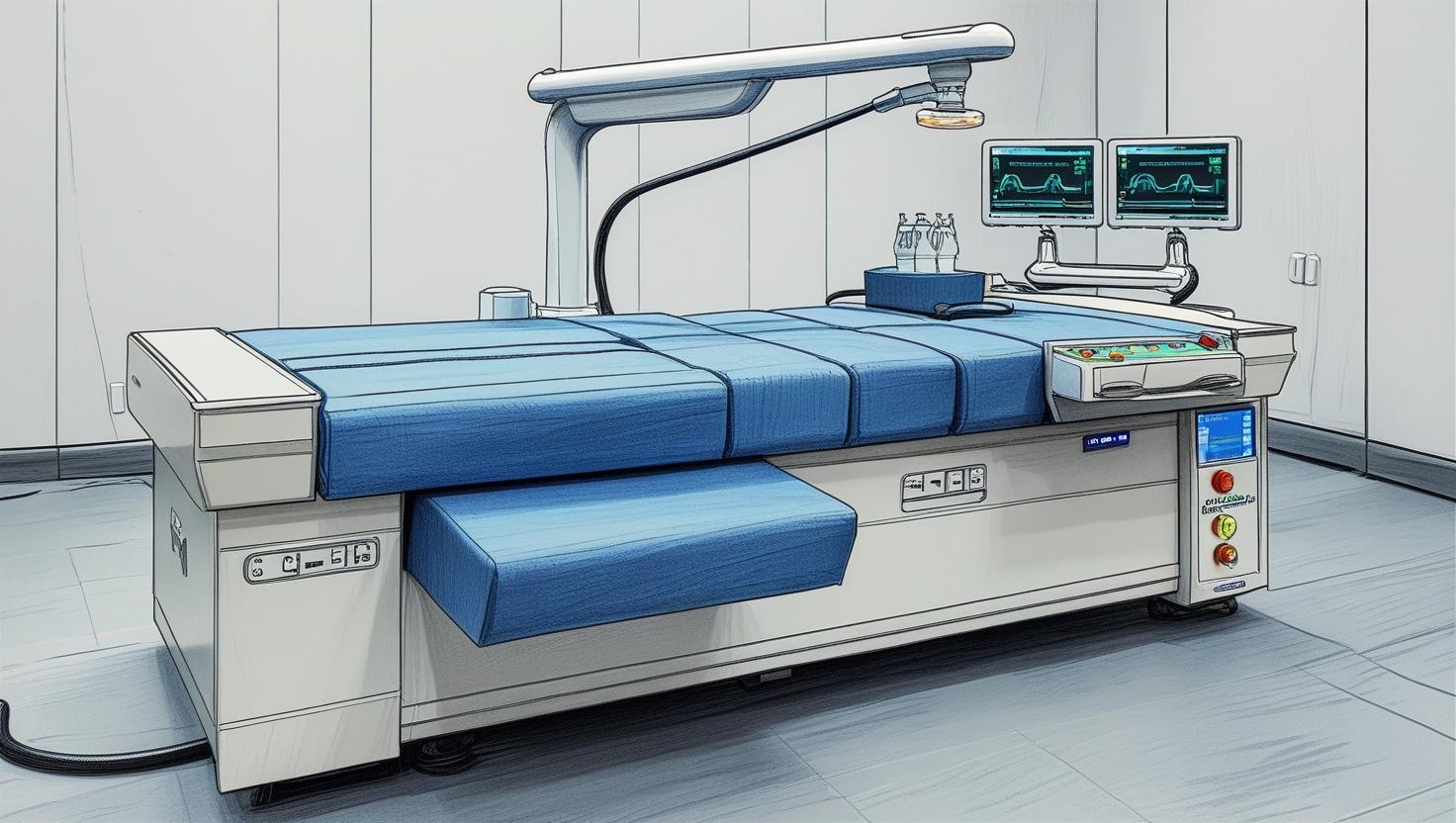
The concept of using heat to fight tumors is surprisingly ancient, but modern hyperthermia systems have turned it into a high-tech tool. These devices create a controlled, localized fever, raising a tumor's temperature to between 40-45°C (104-113°F). Healthy cells can often withstand this heat, but the chaotic and poorly-formed blood vessels in tumors trap heat, causing cancer cells to break down. Hyperthermia is rarely used alone; instead, it acts as a powerful sensitizer, making cancer cells significantly more vulnerable to the effects of radiation and chemotherapy, effectively boosting the power of these conventional treatments.
The 13 sections, in brief
Short summaries of each section. The full lessons, images and quizzes are in the Platform.
Overview
A man is lying on a table with what looks like a large plastic collar around his pelvis. Inside it, antennas are radiating energy into him from several directions at once, and somewhere in the middle of his body a tumour is being held at about forty-two degrees. Not burned. Held, for an hour, roughly four degrees above normal body temperature. He is uncomfortable and awake and talking to the radiographer.
Operations
The patient lies inside or against an applicator, and the type depends on how deep the tumour is. For deep tumours, a ring of antennas surrounds the body and radiates radiofrequency energy inward from multiple directions. Each antenna alone would deposit far too little energy to matter. Where the waves meet and add together, the energy concentrates.
Importance
The case rests on evidence that is better than most people expect. In several cancers, adding hyperthermia to radiotherapy improves local control and, in some, survival. Recurrent breast cancer on the chest wall, where the area has already been irradiated and cannot receive a full dose again. Cervical cancer, where randomised trials showed a genuine benefit. Melanoma recurrences in the skin.
Physics
Physics involved in the Hyperthermia Treatment System: Concept 1, Thermal Dose Physics, Cellular Heat Response, and Controlled Energy Deposition The Hyperthermia Treatment System is a biomedical marvel that uses controlled heat to damage or sensitize pathological tissue, primarily cancer cells, while protecting surrounding healthy regions.
Features
Why the target is forty-two and not sixty Worth settling first, because people assume this device is trying to destroy tissue with heat. Above about sixty degrees, proteins break down and cells die within seconds. That is ablation. A needle goes into the tumour, the tissue around the tip is destroyed, and everything nearby is destroyed with it.
Applications
Recurrent breast cancer on the chest wall The clearest indication and the one where this device has almost no competition. A woman was treated for breast cancer years ago. She had surgery and full-dose radiotherapy. Now the cancer has come back in the skin and soft tissue of the chest wall.
Physiology
This is the most interesting section in the device, because the biology is genuinely clever and it explains why such a mild treatment does anything at all. Four degrees of warming does not kill cancer. What it does is take away the things a tumour uses to survive radiation, and it happens to take them away most in exactly the parts of the tumour that radiation struggles with.
Safety
The safety story here has an unusual shape. The device is not dangerous in the way a radiation machine or a ventilator is. What it mostly does wrong is nothing at all. The commonest failure is a treatment that never reached a useful temperature, delivered an hour of discomfort, and achieved no biological effect, while everybody recorded that it was given.
Advancements
This device has the strangest history in the library: it was nearly killed by its own early results. The biology was noticed first. Heat makes radiation work better, and it works best in the parts of a tumour radiation struggles with. A genuinely good idea with no way to deliver it.
In Research
Almost every unanswered question in this field comes back to one thing. Nobody knows what temperature the tumour actually reached. Which means nobody can say reliably what dose of heat was delivered, whether a treatment worked because the heating was good, or whether a negative trial was testing the treatment or testing a machine that never got hot enough.
Logistics
A significant capital purchase, almost no consumables, and a treatment that frequently does not get paid for. Which makes this the hardest commercial proposition in the library. You are asking a hospital to buy expensive equipment, dedicate a room, employ a physicist, and coordinate two departments, for a treatment that in many countries generates no specific income at all. Every case is then a cost.
Alternatives
This device is never the treatment. It is an addition to radiotherapy or chemotherapy that makes them work better in one region. Which means the alternatives are not other ways of heating tumours. They are other ways of making a treatment more effective in a place where it is not working well enough, and most of them are easier to deliver.
Ethical
Most ethical sections in this library ask whether a treatment is being used too much. There is a treatment with randomised evidence that it improves survival in cervical cancer, and almost nobody offers it. Not because something better replaced it. Because it is awkward to deliver, nobody pays for it, and the results everybody remembers came from machines that could not reach temperature.
Previous: Holter Monitor. Next: Infant Incubator. All 69 devices.
Learn it properly, inside the Platform
22 courses, the 69-device library with 13 sections per device, BMEssentials and BMEssence guides and MedTech AI. Start with a 7-day free trial, no card.
Start the 7-day free trial