
BMEssentia Platform / Device library / Intra Aortic Balloon Pump (IABP)
Device library
Intra Aortic Balloon Pump (IABP)
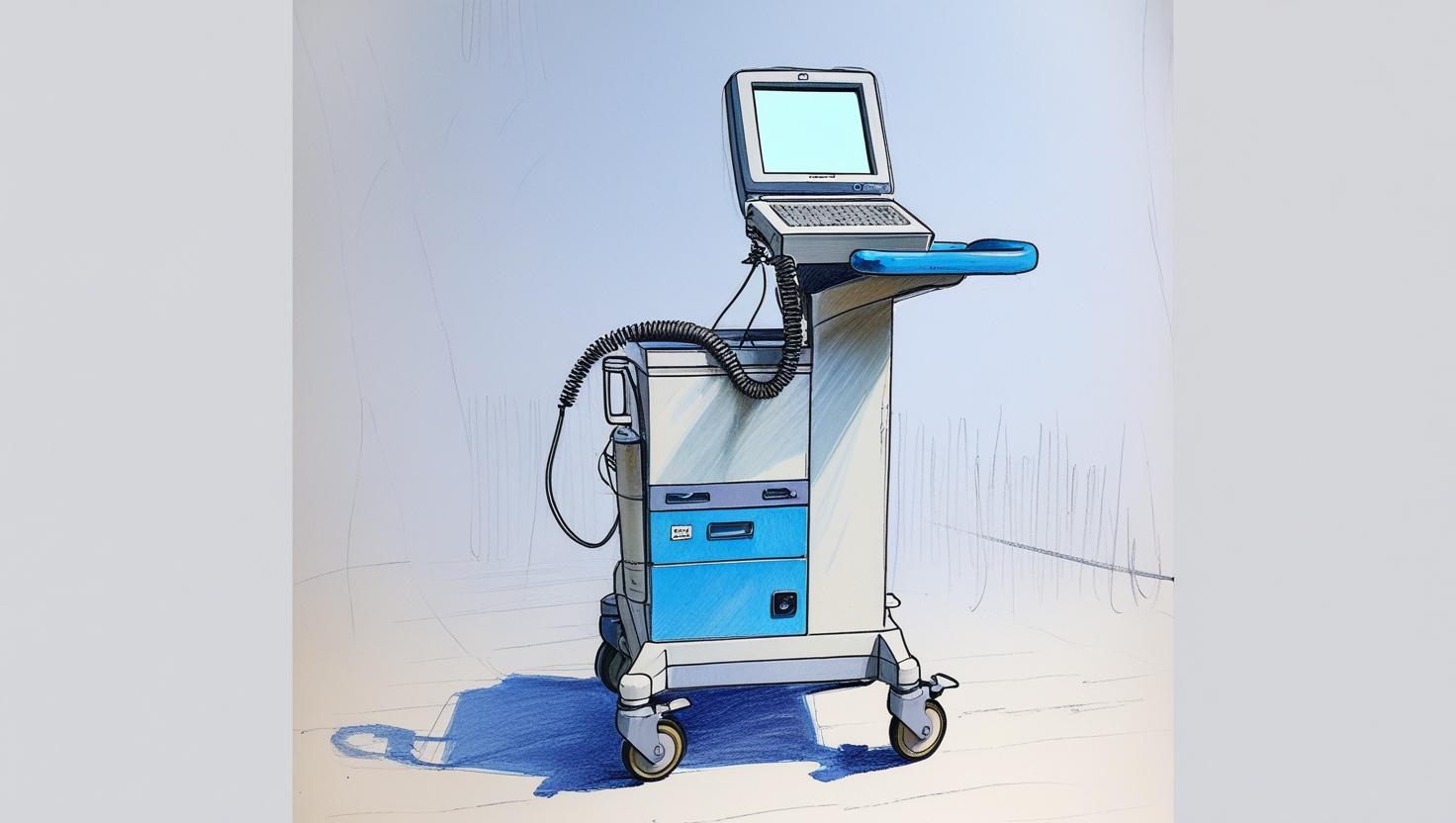
The Intra-Aortic Balloon Pump (IABP), introduced in the 1960s, is a lifesaving device that helps the heart pump blood in patients with severe heart failure or cardiogenic shock. Inserted through the femoral artery, it inflates and deflates in sync with the heartbeat, boosting blood flow by up to 20%. Modern IABPs, like the Maquet Cardiosave, use fiber-optic sensors for precise timing and can reduce mortality risk in critical cases. They're often a bridge to recovery or transplant, stabilizing patients during high-risk cardiac procedures.
The 13 sections, in brief
Short summaries of each section. The full lessons, images and quizzes are in the Platform.
Overview
A man is lying in a coronary care unit with a catheter running from his femoral artery up into his aorta, and at the end of that catheter is a long thin balloon sitting just below the arch, a few centimetres from where the coronary arteries begin. Every time his heart relaxes, the balloon inflates with helium in under a tenth of a second. Every time his heart is about to contract, it deflates just as fast.
Operations
Follow the cardiac cycle and the whole device explains itself. The heart contracts, the aortic valve opens, and blood is ejected into the aorta. At that moment the balloon must be completely deflated, because anything occupying space in the aorta during ejection is something the ventricle has to push against. Then the ventricle finishes ejecting, the aortic valve closes, and diastole begins.
Importance
The case for this device rests on the dual effect, which is genuinely rare in cardiology. It increases oxygen supply to the myocardium and decreases myocardial oxygen demand simultaneously. Consider the alternative. A drug that stimulates the heart to contract harder increases cardiac output and increases oxygen consumption, which in a heart that is failing because it is ischaemic makes the underlying problem worse.
Physics
1, Principle of Counterpulsation and Timing Synchronization The Intra-Aortic Balloon Pump (IABP) is a mechanical circulatory assist device that enhances coronary perfusion and reduces left-ventricular workload through the principle of counterpulsation, an ingenious manipulation of aortic pressure and timing.
Features
Counterpulsation, and the two benefits from one movement Start with the idea, because the hardware is trivial once the idea is clear. The aorta is an elastic tube full of blood. Displace a volume inside it and the pressure rises. Remove that volume suddenly and the pressure falls.
Applications
Cardiogenic shock after myocardial infarction The historical mainstay, and the case study. A large infarct damages enough muscle that the heart cannot maintain an adequate circulation. Blood pressure falls, coronary perfusion falls, more muscle becomes ischaemic, contractility falls further.
Physiology
This device has almost no engineering in it. A balloon, a gas, a timer. Which means the physiology is the device. Everything it achieves, everything it fails to achieve, and every situation in which it causes harm follows directly from how blood behaves in an elastic tube attached to a muscular pump.
Safety
This device is simple, cheap, quickly inserted, and easily removed. Which produces a specific safety problem that does not exist for the more complex machines in this library. Nobody is frightened of it. A bypass circuit commands attention because everyone in the room knows what it does.
Advancements
Forget release years. The shape predicts direction, and this device has a shape unlike anything else in the library. It was invented, refined, adopted universally, tested, and demoted. Not obsoleted. Demoted, by evidence, in the indication it was most used for.
In Research
Every device in this library has open questions. This one has something rarer and more instructive. The physiology is correct. The mechanism is demonstrable. The haemodynamic effect is measurable in any patient you attach it to. And when it was finally tested in the condition it was most used for, it did not save lives.
Logistics
An engineer who understands counterpulsation is useful. An engineer who understands how to run a product whose market is shrinking understands something most people in this industry never have to learn. Because this is the commercial case study of the library. Every other device here is growing, stable, or being replaced by something better.
Alternatives
An alternative is not a competing product. It is another way of achieving the clinical goal, and the goal here is to improve myocardial oxygen balance and support a circulation while something reversible reverses. This section is unusual because this device has already lost a comparison. It was compared against nothing at all, in its largest indication, and nothing won.
Ethical
Most ethical sections in this library concern what a device does to a patient. This one is different, and it is the most important ethics section in the whole library, because the central question is not about counterpulsation at all. A device was used on millions of people, for decades, on the strength of a mechanism that was entirely correct, and nobody checked whether it helped.
Previous: Insulin Pump. Next: Intraoperative Neurophysiological Monitoring (IONM) System. All 69 devices.
Learn it properly, inside the Platform
22 courses, the 69-device library with 13 sections per device, BMEssentials and BMEssence guides and MedTech AI. Start with a 7-day free trial, no card.
Start the 7-day free trial