
BMEssentia Platform / Device library / Intraoperative Neurophysiological Monitoring (IONM) System
Device library
Intraoperative Neurophysiological Monitoring (IONM) System
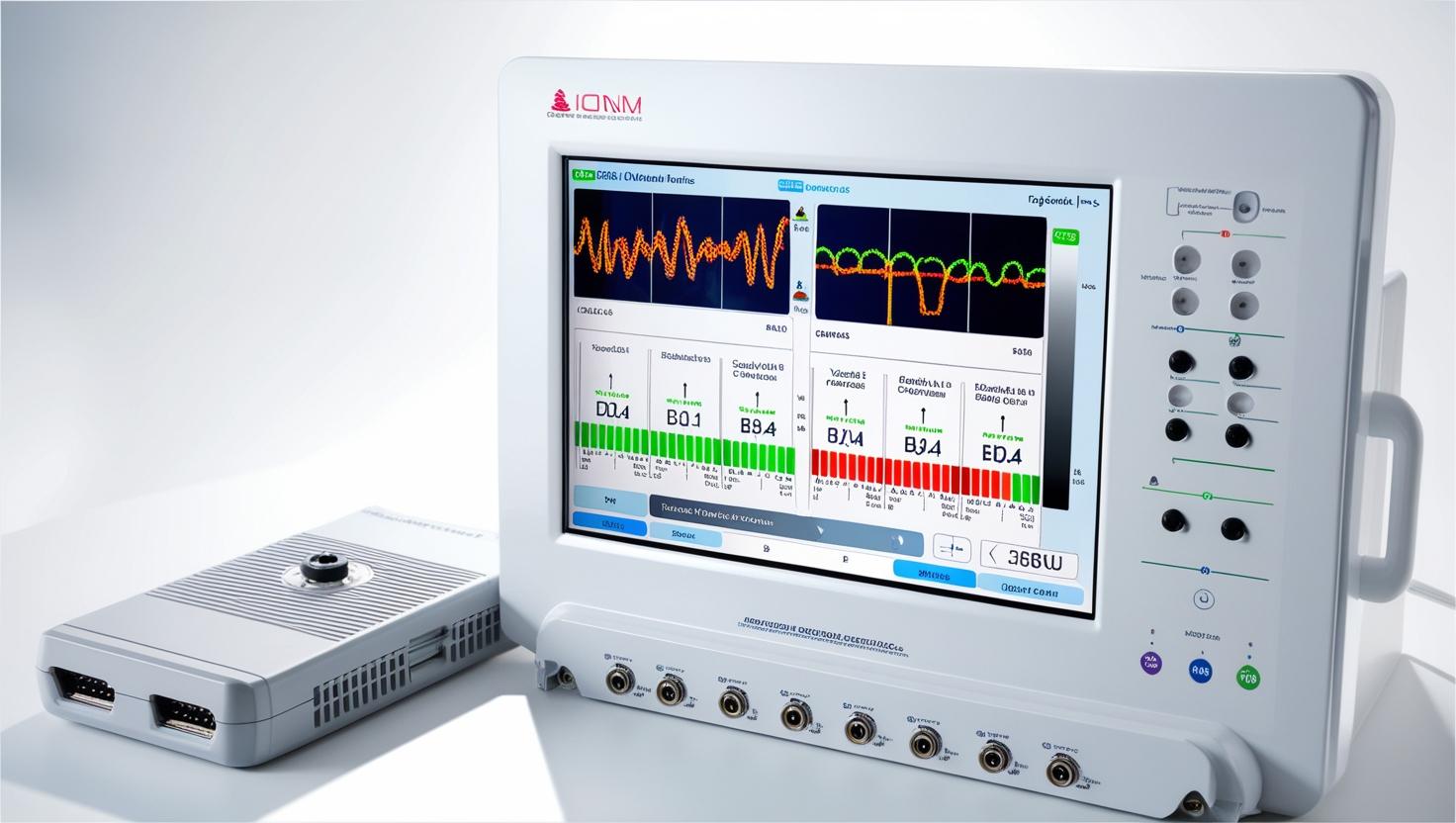
The Intraoperative Neurophysiological Monitoring (IONM) System is used during surgeries to monitor the nervous system in real time. It helps protect the brain, spinal cord, and nerves by detecting potential injuries before they become permanent. Surgeons rely on IONM to avoid nerve damage during complex procedures like spinal, brain, or vascular surgeries. This system uses electrodes to measure electrical signals and provides instant feedback to the surgical team.
The 13 sections, in brief
Short summaries of each section. The full lessons, images and quizzes are in the Platform.
Overview
A surgeon is straightening a spine. The rods are in, the curve is coming down, and the correction is going well. Somewhere in the room a technologist watching a screen says a sentence that stops everything: the signals from the legs have dropped. Not gone. Dropped, by an amount that crosses a threshold everybody in the room agreed on before the case started. The surgeon stops pulling.
Operations
Follow the signal and it explains itself. For sensory monitoring, a stimulating electrode delivers a small pulse to a peripheral nerve at the wrist or ankle. That impulse travels up the peripheral nerve, into the spinal cord, up the sensory columns, through the brainstem, to the sensory cortex. Recording electrodes on the scalp capture the response.
Importance
The case rests on one thing. Surgery near the nervous system carries a risk of permanent neurological injury, and without monitoring that injury is discovered after it has become irreversible. In scoliosis correction, the cord is being stretched and derotated. In intramedullary tumour surgery, the surgeon is working inside the cord itself. In carotid surgery, the brain's blood supply is interrupted.
Physics
Physics Involved in the Intraoperative Neurophysiological Monitoring (IONM) System: Concept 1, Neural Signal Foundations, Evoked Potential Dynamics, and Real-Time Neuroelectric Integrity During delicate surgeries, spinal corrections, tumor resections, carotid endarterectomies, or aneurysm clippings, a patient's nervous system walks a tightrope between recovery and irreversible damage.
Features
Averaging, and pulling a signal out of noise The foundational trick of sensory monitoring and it deserves building properly. Stimulate a nerve at the wrist and a response arrives at the sensory cortex. That response is tiny. Far smaller than the ongoing background electrical activity of the brain, and far smaller than the electrical noise of an operating theatre.
Applications
Scoliosis and spinal deformity correction The largest application and the clearest. Correcting a curved spine means distracting, derotating and realigning a column that contains the spinal cord. The cord is stretched, its blood supply is altered, and instrumentation is placed within millimetres of nerve roots.
Physiology
This device measures conduction in living neural tissue, which means every signal it produces is a statement about cellular physiology happening in real time. And the single most important physiological fact in the whole device is this: there is a window between the moment a neuron stops working and the moment it dies. Inside that window everything is reversible. Outside it nothing is.
Safety
False reassurance, the most dangerous failure The worst thing this device can do is work incorrectly while appearing to work. The wrong pathway is monitored. Sensory monitoring alone during an operation risking the motor tracts produces normal traces throughout a developing paraplegia.
Advancements
Forget release years. The shape predicts direction, and this device has a shape driven by a single recurring discovery: the thing being monitored was not the thing at risk. The wake-up test. Before any electronics, the patient was woken mid-operation, asked to move their feet, and re-anaesthetised.
In Research
When monitoring works, an alert occurs, something is changed, the signals recover, and the patient wakes normal. And nobody can prove that patient was going to be paralysed. There is no scan of the injury that did not happen. The outcome of a successful intervention is indistinguishable from the outcome of an operation where nothing was ever wrong, which means this device's benefit can never be directly counted.
Logistics
An engineer who understands this device is useful. An engineer who understands that the equipment is a minor part of the cost and the person operating it is the entire business understands what is actually being sold. Because this device has a commercial structure unlike anything else in the library.
Alternatives
An alternative is not a competing product. It is another way of achieving the goal, and the goal here is not monitoring. It is a patient who wakes up neurologically intact. Which opens the section wider than usual, because several of the most effective alternatives are not monitoring at all.
Ethical
This device does not injure people. It watches. Which places its ethical weight somewhere unusual. The entire function of this machine is to give one person in the room the standing to interrupt another. Everything else, the amplifiers, the thresholds, the electrodes, exists to make that interruption credible.
Previous: Intra Aortic Balloon Pump (IABP). Next: Intravascular Ultrasound (IVUS) System. All 69 devices.
Learn it properly, inside the Platform
22 courses, the 69-device library with 13 sections per device, BMEssentials and BMEssence guides and MedTech AI. Start with a 7-day free trial, no card.
Start the 7-day free trial