
BMEssentia Platform / Device library / Magnetic Resonance Imaging (MRI)
Device library
Magnetic Resonance Imaging (MRI)
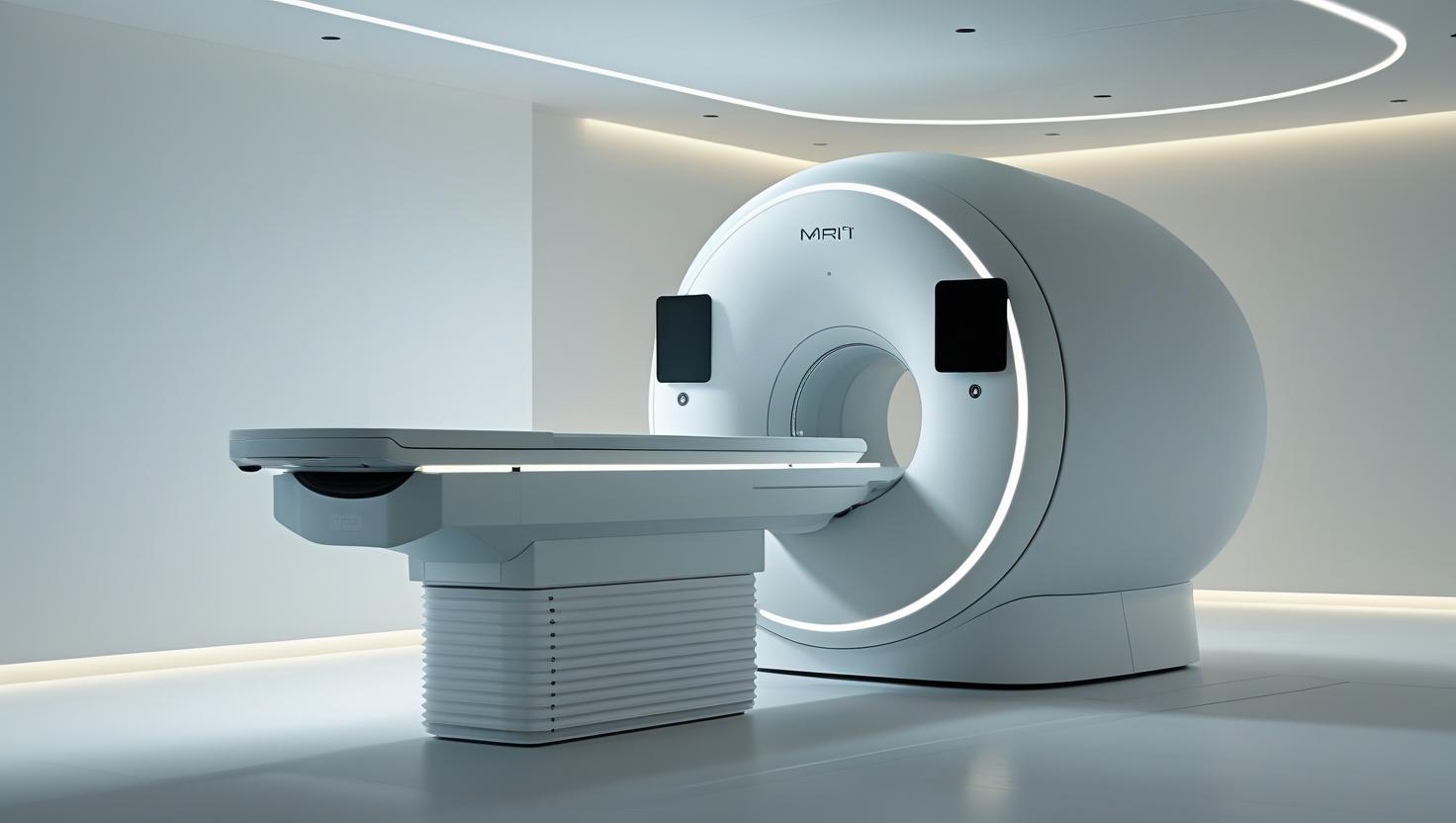
Magnetic Resonance Imaging (MRI) uses powerful magnets and radio waves to produce detailed images of the body's internal structures without using harmful radiation. It's especially useful for imaging the brain, spinal cord, joints, and soft tissues. Interestingly, the loud noises heard during an MRI scan are due to the vibration of coils as they rapidly switch currents. Patients with metal implants must be carefully screened, as the strong magnetic field can affect them.
The 13 sections, in brief
Short summaries of each section. The full lessons, images and quizzes are in the Platform.
Overview
A cleaner walks into an MRI suite at the end of a shift, pushing a steel mop bucket, because nobody told them this room was different from the other rooms. The magnet is not scanning. Nothing is humming. There is no light on, no warning sound, nothing that announces danger to a person who has not been trained. Six feet from the bore the bucket becomes slightly harder to push.
Operations
Follow a patient through and the machine assembles itself in front of you. Before they enter the room they are screened, and screened again, because the single most dangerous step in this entire procedure happens before any imaging occurs. Every implant, every surgical clip, every fragment of metal from an old injury, every piece of jewellery, every pocket, is accounted for.
Importance
The case for MRI rests on one property that nothing else in medicine matches: it distinguishes between soft tissues that are physically almost identical. An X-ray or CT image is built from how much radiation different tissues absorb, which depends mainly on density, and the unhappy truth is that most soft tissue in the human body has almost the same density. Grey matter and white matter.
Physics
Imagine billions of tiny spinning tops (hydrogen protons) inside your body. Each one spins on its own axis, and because they're charged particles, this spinning creates a tiny magnetic field around each proton - making each one act like a microscopic bar magnet.
Features
The magnet, and the thing that makes it terrifying Everything else in this machine is negotiable. The magnet is not. Inside the housing sits a coil of superconducting wire, typically niobium-titanium, wound into a cylinder and immersed in liquid helium at around four degrees above absolute zero. At that temperature the wire has no electrical resistance whatsoever. Not low resistance. None.
Applications
Neurology and neurosurgery: the place where MRI is simply not optional If you take one thing from this section, take this: for the brain and spinal cord, MRI is not the better option, it is frequently the only option. CT shows a brain as a fairly uniform grey mass with some structures visible.
Physiology
MRI machines are versatile tools used to image nearly every major body system. Each system can be explored in detail using MRI's high-resolution images, which allow clinicians to differentiate between various tissue types.
Safety
Every other imaging device carries a hazard you can measure, limit, and accumulate. Radiation dose is counted. Exposure is logged. Risk is stochastic and proportional. MRI is different in a way that shapes its entire safety culture. The primary hazards are mechanical, thermal, and acoustic, they are not cumulative, and they are almost entirely preventable by procedure rather than by shielding.
Advancements
Forget release years. What you want is the shape of how this field moved, because the shape tells you where it goes next and it stays true for a decade. MRI moved in five distinct waves, and each one solved a problem created by the wave before it. First, the physics escaped the laboratory.
In Research
MRI is one of the most studied devices in the history of medicine. Tens of thousands of papers a year. Entire academic departments devoted to it. Physics, engineering, mathematics, neuroscience, and clinical medicine all working on the same instrument.
Logistics
An engineer who understands how MRI works is useful. An engineer who understands how an MRI scanner arrives in a country, gets into a building, gets installed, gets registered, gets serviced, and keeps running is the person who runs a distributorship or a hospital imaging programme.
Alternatives
An alternative is not a competing product. It is another way of answering the clinical question, and the honest comparison changes completely depending on what is being asked, about whom, and in what circumstances. Anyone who tells you MRI is the best imaging modality is speaking imprecisely.
Ethical
MRI raises ethical questions that most devices do not, because it is scarce, expensive, extraordinarily informative, and capable of revealing things nobody was looking for, including things about a person's brain that they did not consent to learn. You will meet these questions whether or not you have thought about them.
Previous: Magnet Controlled Capsule Endoscopy (MCCE). Next: Mechanical Ventilators. All 69 devices.
Learn it properly, inside the Platform
22 courses, the 69-device library with 13 sections per device, BMEssentials and BMEssence guides and MedTech AI. Start with a 7-day free trial, no card.
Start the 7-day free trial