
BMEssentia Platform / Device library / Mechanical Ventilators
Device library
Mechanical Ventilators
Mechanical ventilators, first widely used in the 1920s with the "iron lung," support breathing for patients with respiratory failure, transforming critical care. Early models were bulky and manually operated, but modern ventilators, like those from Philips, use advanced sensors and algorithms to adjust airflow and oxygen levels in real-time. Some portable units now fit in a backpack, enabling mobility for chronic respiratory patients. These devices have been lifesavers in ICUs, especially during pandemics like COVID-19.
The 13 sections, in brief
Short summaries of each section. The full lessons, images and quizzes are in the Platform.
Overview
A woman is lying in an intensive care bed, sedated, with a tube passing between her vocal cords into her trachea, and every four seconds a machine beside her delivers a breath. It has delivered around twenty thousand of them since yesterday morning. Her chest rises, her chest falls, and the numbers on the screen are acceptable.
Operations
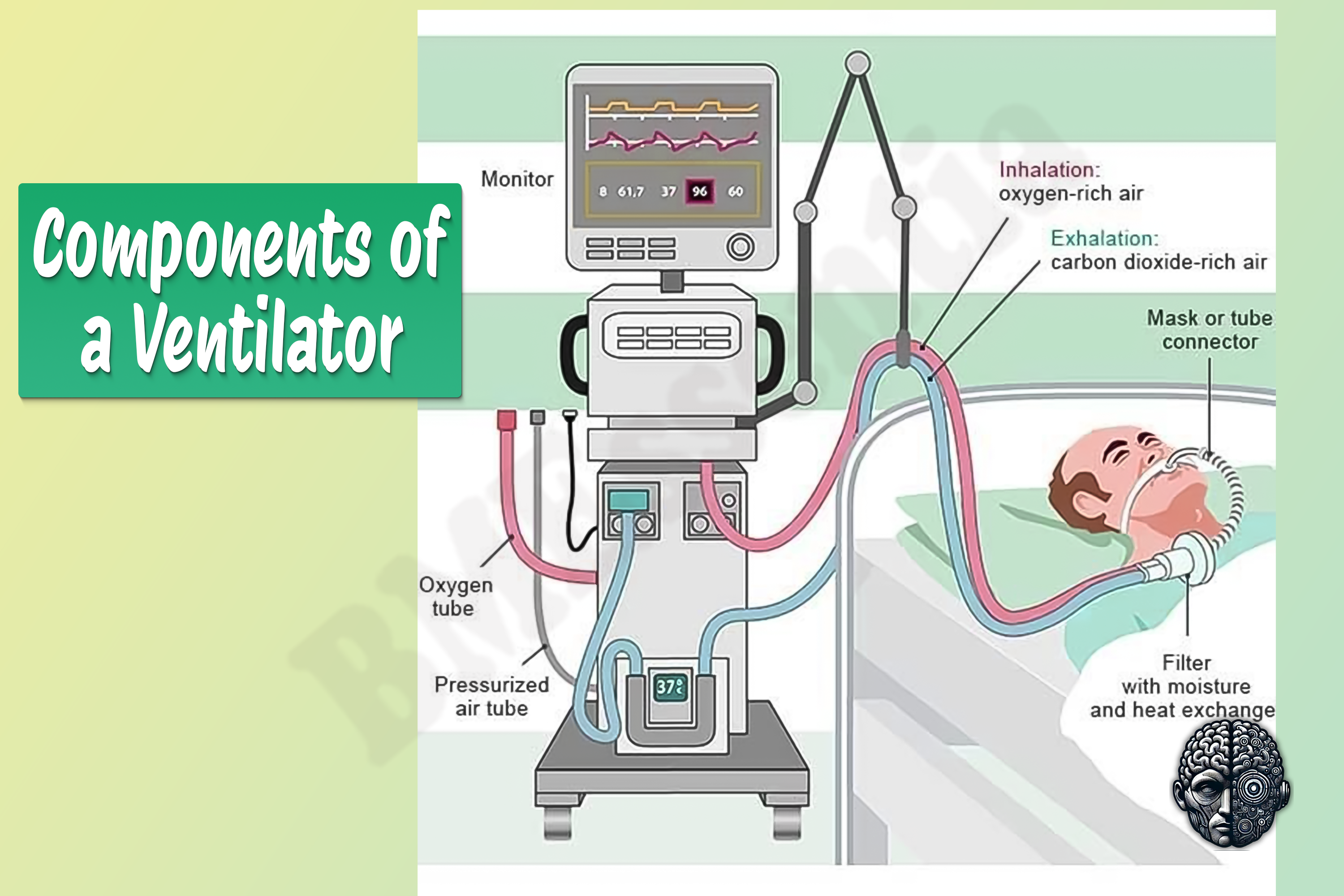
Follow a single breath and the machine explains itself. The ventilator holds a supply of gas at a set oxygen concentration, humidified and warmed, because the upper airway that normally performs both has been bypassed by the tube. It opens an inspiratory valve and gas flows into the patient's lungs.
Importance
The case for this machine requires almost no argument, which is rare in this library. Without it, any illness or injury that prevents adequate breathing is fatal within minutes. A drug overdose that suppresses the respiratory drive. A cervical spinal injury that paralyses the diaphragm. A severe asthma attack. Pneumonia that floods enough alveoli.
Physics
Physics Involved in the Ventilator Device: 1, Functional Architecture & Respiratory Circuit Design A modern mechanical ventilator is a closed-loop gas-delivery system that replicates and assists the natural act of breathing by controlling pressure, flow, and volume within the patient's airways.
Features
Positive pressure, and the inversion that explains everything Start here, because every consequence in this device descends from it. Your diaphragm descended and your ribs lifted outward. Your chest got bigger before any air arrived. Enlarging the container dropped the pressure inside it below atmospheric, and air moved in to equalise.
Applications
The alveoli are flooded, consolidated or collapsed, so oxygen cannot cross into the blood however much air arrives. Severe acute respiratory distress syndrome. The defining application and the one that reshaped the entire field. Inflammation makes the alveolar membrane leaky, so protein-rich fluid floods the airspaces.
Physiology
Every setting on this machine is a physiological decision wearing a number. Which means a person can operate a ventilator competently without understanding the physiology, and cannot operate one safely, because the harms are invisible on the screen and legible only in the physiology.
Safety
Almost every safety section in this library is about a machine failing. Modern ventilators are extraordinarily reliable. The overwhelming majority of harm they cause happens while they are working perfectly, delivering exactly the breath somebody asked for, into a lung that cannot tolerate it. The dangerous part of this device is the settings, and the settings look like numbers rather than like decisions.
Advancements
Forget release years. The shape predicts direction, and this device has the most humbling shape in the library. Negative pressure first. The earliest machines enclosed the body in a sealed chamber and cycled the pressure around it, expanding the chest from outside. Physiologically faithful, and enormous, and it left the patient inaccessible to any nursing care at all.
In Research
This is the most studied device in critical care. It has been in continuous use for generations, it is in every intensive care unit and every operating theatre on earth, and it generates a complete second-by-second record of everything it does. And the two largest improvements in its entire history were turning a dial down and waking the patient up.
Logistics
An engineer who understands ventilation is useful. An engineer who understands that a hospital with a hundred ventilators and no piped oxygen has a hundred pieces of furniture understands what is actually being sold. This device has a logistics profile unlike anything else in the library, for one reason.
Alternatives
An alternative is not a competing product. It is another way of achieving the clinical goal, and the goal here is not to ventilate somebody. It is adequate gas exchange with the least damage done along the way. Which reframes this section entirely, because the alternatives to invasive ventilation are not other ventilators.
Ethical
This machine sits at the centre of more ethical difficulty than anything else in this library, and for a specific reason. It is the most common organ support in the world, it is frequently started in minutes by people who have never met the patient, and once it is running the decision to stop it is a decision that ends a life. Nobody has to decide to continue. Continuing is what happens by default.
Previous: Magnetic Resonance Imaging (MRI). Next: Nebulizer. All 69 devices.
Learn it properly, inside the Platform
22 courses, the 69-device library with 13 sections per device, BMEssentials and BMEssence guides and MedTech AI. Start with a 7-day free trial, no card.
Start the 7-day free trial