
BMEssentia Platform / Device library / Orthopedic Implants
Device library
Orthopedic Implants
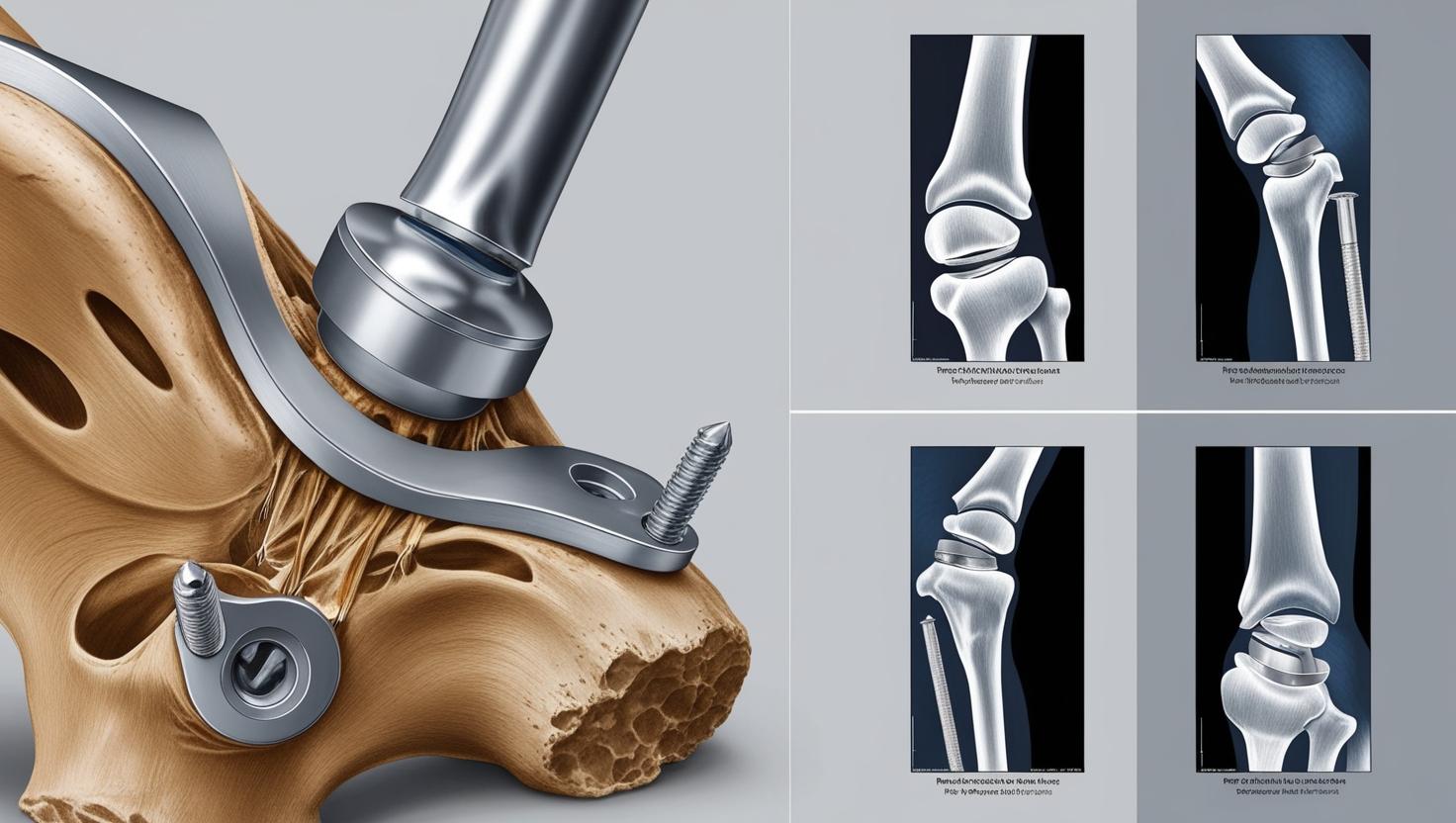
Orthopedic implants are medical devices designed to replace or support damaged bones and joints, restoring mobility and function. Made from biocompatible materials like titanium, stainless steel, or polyethylene, these implants include joint replacements, plates, screws, and rods for fracture fixation. Modern designs incorporate porous surfaces that encourage bone growth for better integration and longevity. Computer-assisted navigation and 3D-printed custom implants now allow for personalized solutions tailored to individual anatomies. These devices play crucial roles in treating arthritis, fractures, and degenerative conditions, significantly improving patients' quality of life. Ongoing.
The 13 sections, in brief
Short summaries of each section. The full lessons, images and quizzes are in the Platform.
Overview
A man of sixty-eight is standing at the top of a flight of stairs six weeks after a hip replacement, and he is about to do something nobody warned him about properly. He is fine. That is the point. His pain is gone, which it was not before the operation, and it went almost immediately, which is why hip replacement is one of the most satisfying operations in medicine.
Operations
Follow the load. It explains almost every design decision. In a normal hip, force from the body passes down through the pelvis, across the socket, through the ball of the femur, and down the femoral neck into the shaft. That load is distributed across cartilage a few millimetres thick, lubricated by synovial fluid, with a coefficient of friction lower than ice on ice.
Importance
The first argument is about pain, and it is stronger than almost anything else in this library. Hip replacement is one of the most effective operations ever devised. Not in survival terms. In terms of a person's day. Somebody with end-stage hip arthritis cannot walk to the shops, cannot sleep through the night, cannot put on their own socks, and has been taking painkillers for years.
Physics
Physics Involved in the Orthopedic implants Device: Concept 1, Biomechanical Architecture and Osseointegrative Design of Orthopedic Implants An orthopedic implant is not merely a piece of metal placed in bone; it is a precisely engineered biomechanical substitute that assumes the load-bearing, motion-transmitting, and biological-anchoring functions of the musculoskeletal system.
Features
Start here, because it is the source of most long-term failure. A ball articulating in a socket, carrying several times body weight, through around a million cycles a year, for decades, lubricated only by joint fluid. It has to be smooth enough not to abrade, hard enough not to deform, and tough enough not to crack.
Applications
The largest elective application and one of the most effective operations in medicine. Groin pain on walking. Pain at night that wakes them. A limp. Difficulty putting on socks and shoes, which sounds trivial and is one of the most reliable markers of how bad a hip has become.
Physiology
Run this in both directions, and this is one of the few devices in the library where the second direction dominates completely. What the device does to the body: it changes how load passes through bone, and it sheds particles. What the body does to the device: it grows onto it, remodels around it, attacks its debris, and eventually dissolves the bone holding it in place.
Safety
These are mostly elective operations, on people who are not ill, done to relieve pain. Which sets the bar differently from almost everything else in this library. A complication in a ventilated patient is weighed against dying. A complication here is weighed against a hip that hurt.
Advancements
Forget release years. This field has a distinctive shape: one enormous original insight, followed by decades of materials refinement, punctuated by a catastrophe that the industry caused and a database detected. Early attempts at joint replacement failed on friction and wear. The mechanics were obvious and the materials did not exist.
In Research
The field that counts, and what counting revealed Orthopaedics did something almost nothing else in this library did. It built national registries and recorded every implant and every revision. Which turned out to be the most powerful safety instrument in medical devices, and it produced findings the field did not want.
Logistics
An engineer who understands these devices is useful. An engineer who understands that the implant is one item and the instrument sets weigh more than the patient understands what is actually being moved.
Alternatives
An alternative is not a competing product. It is another way of answering the clinical question, and here the question is almost never which implant. This person's joint hurts and they cannot do what they want to do. What is the best route back to that?
Ethical
Most devices in this library are used on people who are ill. Which changes everything about the ethics. A patient having a knee replacement walked into the hospital. They were living their life, in pain, and they chose this.
Previous: Ophthalmoscope. Next: Otoscope. All 69 devices.
Learn it properly, inside the Platform
22 courses, the 69-device library with 13 sections per device, BMEssentials and BMEssence guides and MedTech AI. Start with a 7-day free trial, no card.
Start the 7-day free trial