
BMEssentia Platform / Device library / Percutaneous Nephrolithotomy (PCNL) System
Device library
Percutaneous Nephrolithotomy (PCNL) System
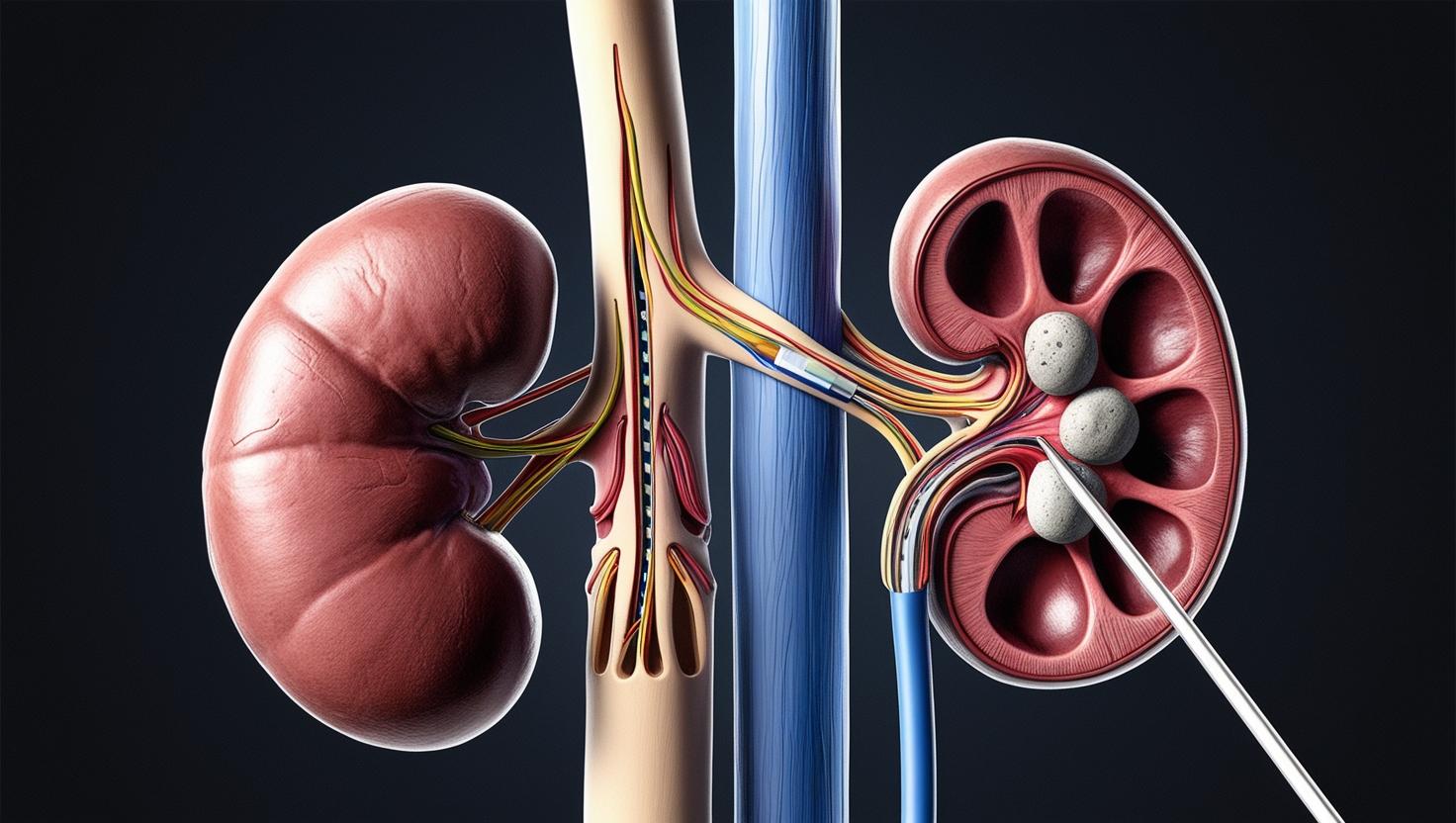
The Percutaneous Nephrolithotomy (PCNL) System is used to remove large or complex kidney stones through a small incision in the back. Unlike traditional open surgery, PCNL is minimally invasive and offers faster recovery. A thin tube is inserted into the kidney to break and extract stones using ultrasound, laser, or pneumatic energy. This system is highly effective for stones that can't be treated with shock wave therapy or medication.
The 13 sections, in brief
Short summaries of each section. The full lessons, images and quizzes are in the Platform.
Overview
A patient is face down on the table with their back exposed. There is no incision. A surgeon holds a needle against the skin below the twelfth rib, watching a screen, and pushes it in. The needle travels through skin, fat, muscle, and then through the outer capsule of a kidney, and stops inside a space about the size of a thimble. Urine comes back through the hub. That is confirmation.
Operations
Follow the wire and the whole operation explains itself. Before anything is punctured, a thin catheter usually goes up the ureter from the bladder. It does two jobs. Fluid injected through it swells the collecting system, which turns a narrow target into a wider one. And later it blocks fragments from washing down the ureter, where they would cause exactly the obstruction the operation was meant to remove.
Importance
The first argument is about what this replaced. A large kidney stone used to mean open surgery. A long cut through the flank, muscle divided, the kidney mobilised and then opened, the stone lifted out, the kidney closed. A scar running round the side of the body. A week or more in hospital. Weeks before returning to work. And a kidney that had been cut, with permanent scarring in an organ whose function matters.
Physics
Physics Involved in the Percutaneous Nephrolithotomy (PCNL) System: Concept 1, System Architecture and Core Mechanism The Percutaneous Nephrolithotomy (PCNL) system is a complete, closed-loop surgical ecosystem built to remove large renal calculi through a precisely engineered percutaneous tract.
Features
The puncture, and the only corridor into a kidney Start here, because every consequence descends from it. The kidney's drainage system is shaped roughly like a hand. A central basin, with stalks branching off it, each stalk ending in a cup. Urine filters out of kidney tissue into the cups, runs down the stalks, collects in the basin, and leaves down the ureter.
Applications
Above roughly two centimetres, PCNL clears a stone in one session far more reliably than anything else. Shock waves can break a stone that size and then the patient has to pass the fragments, which for a large stone means a long tail of pain, obstruction and repeat treatments. Flexible ureteroscopy can clear it in several operations over several months.
Physiology
Run this in both directions, because the second direction is the one that kills. What the body does to the device: it bleeds into the tunnel, it resists at every layer, it slides away from the needle, and it moves with every breath. What the device does to the body: it raises pressure inside a closed organ, it forces fluid into the circulation, and it opens a stone that has been storing bacteria for years.
Safety
Two complications dominate this operation and they behave in opposite ways. Bleeding is visible, immediate and manageable. Everybody in the room knows it is happening and everybody knows what to do. Sepsis is invisible, delayed, and it kills. The operation finishes, the patient looks well, somebody writes an uneventful operation note, and the deterioration starts three hours later on a ward.
Advancements
This device has an unusually clean shape, because progress has run in one direction for a generation: make the hole smaller. Somebody put a needle into a kidney and drained it. Nephrostomy, for obstruction, with no intention of treating stones. The route existed before anybody thought of using it as a door.
In Research
The problem underneath the whole literature Two hospitals report their PCNL results. One says ninety percent stone-free. One says seventy. You cannot compare those numbers, and the reason is not surgical skill. One scanned every patient with CT at three months. One took a plain X-ray on the second day. One counts any fragment. One counts fragments above four millimetres. One measured at discharge, one at six weeks.
Logistics
An engineer who understands this operation is useful. An engineer who understands that there is no PCNL machine, and that what a hospital is actually buying is a set from four different suppliers that has to work together on a table, understands what is being sold.
Alternatives
An alternative is not a competing product. It is another way of answering the clinical question, and the question here is specific. Not "how do we treat kidney stones." It is: this particular stone, in this particular cup, in this particular patient, has to come out. What is the least damaging way to achieve that?
Ethical
Most operations in this library carry an ethical weight that comes from what is being done to the patient. Here it comes from something narrower. The most consequential step in this operation is frequently performed by somebody who is not particularly good at it, and the patient has no way of knowing that.
Previous: Otoscope. Next: Peritoneal Dialysis Cycler. All 69 devices.
Learn it properly, inside the Platform
22 courses, the 69-device library with 13 sections per device, BMEssentials and BMEssence guides and MedTech AI. Start with a 7-day free trial, no card.
Start the 7-day free trial