
BMEssentia Platform / Device library / Peritoneal Dialysis Cycler
Device library
Peritoneal Dialysis Cycler
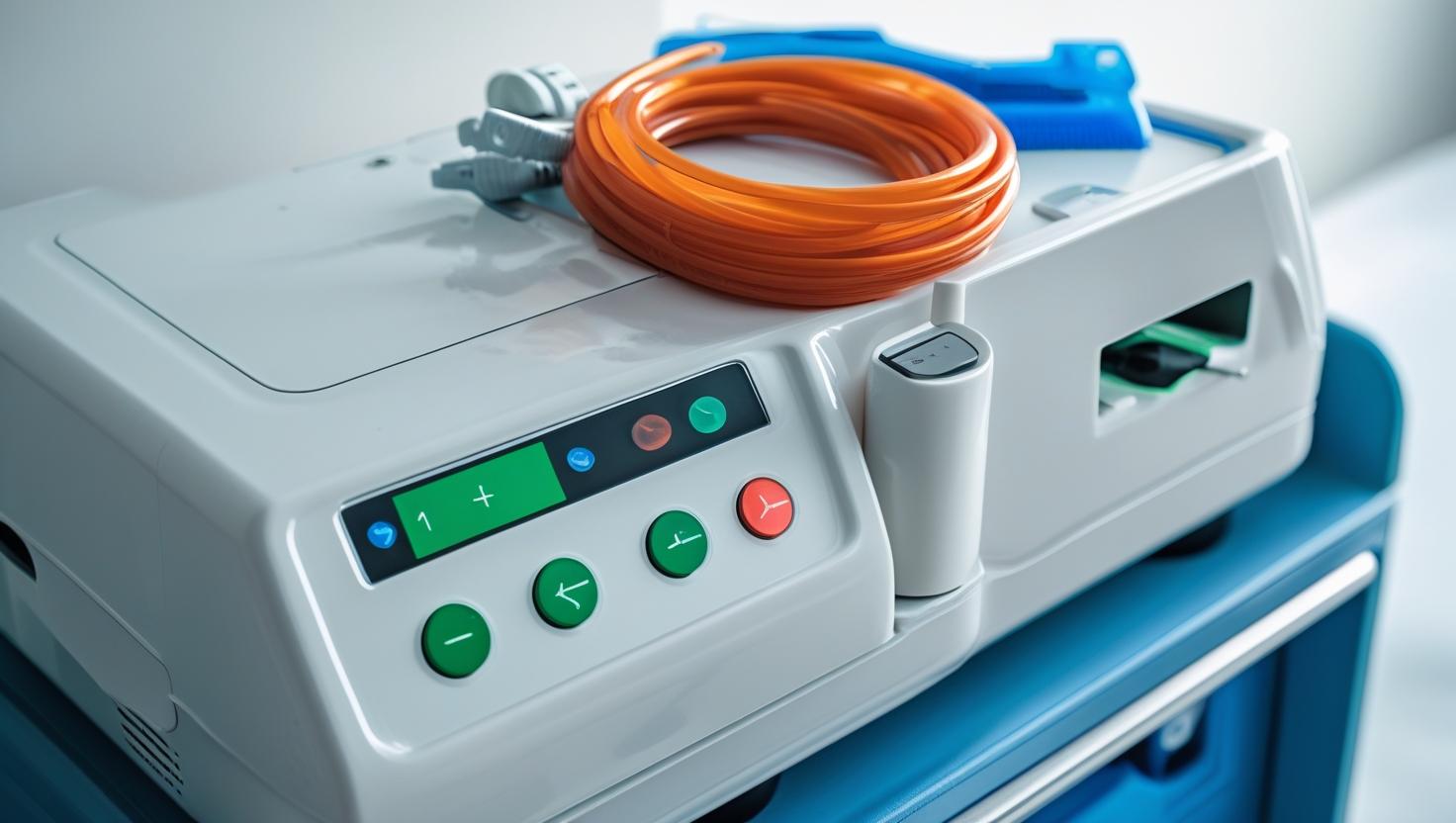
Peritoneal dialysis cyclers, introduced in the 1970s, automate dialysis by cycling dialysate fluid in and out of the abdomen while patients sleep, typically over 8-12 hours. These machines, like the Baxter HomeChoice or Fresenius Liberty Select, perform 3-5 exchanges nightly, offering more freedom during the day compared to manual dialysis. Modern cyclers feature remote monitoring, allowing clinicians to adjust treatments via cloud-based platforms, reducing hospital visits. They're compact, fitting on a bedside table, and use smart alarms to ensure safe operation.
The 13 sections, in brief
Short summaries of each section. The full lessons, images and quizzes are in the Platform.
Overview
It is twenty past three in the morning and a machine is beeping in a bedroom. A woman reaches over and squints at a screen that says the drain is slow. She has been asleep for four hours and has three cycles left. She knows what to do because she has done it forty times: roll onto her other side, pull her knees up, wait. Sometimes that works.
Operations
Follow the fluid and the machine explains itself. It starts with the bags. Several of them, typically two to three litres each, hung on the machine or sitting on a shelf beside it. The patient loads a cassette, a disposable plastic manifold containing the tubing pathways, into the front of the machine.
Importance
The first argument is about time, and it is the one patients actually care about. Manual exchanges take roughly half an hour each, four or five times a day. That is two to three hours every day, in fragments, each one requiring a clean space and a pause in whatever the person was doing. It means no full working day without an exchange at work. No long meeting. No journey without carrying supplies.
Physics
Physics Involved in the Peritoneal Dialysis Cycler: Concept 1, Automated Dialysis Exchange Sequence and System Architecture The Peritoneal Dialysis Cycler (PDC) is not merely a pump, it is a synchronized artificial organ, designed to replicate and optimize the continuous purification role of the kidney during sleep.
Features
The cassette, and why the machine never touches the fluid The single most important design decision in the device. A machine sitting in a bedroom for years cannot be sterilised between uses. It cannot be autoclaved, it cannot be soaked, and it lives on a bedside table next to a glass of water.
Applications
The largest application and the most straightforward. Manual exchanges require a clean private space four or five times a day. Which means a workplace that provides one, a schedule with gaps in it, and a willingness to explain to colleagues why you disappear for half an hour after lunch.
Physiology
Two things happen physiologically that are specific to this machine rather than to peritoneal dialysis in general. The treatment happens at night, in a horizontal person who is asleep. And it happens in short cycles rather than long dwells, which changes what gets cleared and what does not.
Safety
This machine has almost no capacity to kill anybody directly, and that is worth stating first because it shapes everything else. There is no blood circuit. No air embolism risk into a vein. No exsanguination. No dialysate composition that can burst red cells. The volumes are small and the pressures are low.
Advancements
Forget release years. This machine has a shape and it is unusual: the hardware was adequate almost immediately and every real advance since has been about the patient rather than the pump. Peritoneal dialysis was performed by hand, and it worked, and it consumed the patient's day. The therapy existed and the burden of it was the limiting factor.
In Research
This machine exists to improve quality of life. That is its stated purpose and it is a reasonable one. And the outcome that most directly determines quality of life for somebody on this therapy, how well they sleep, has almost never been measured in any trial of it.
Logistics
An engineer who understands this machine is useful. An engineer who understands that the machine is nearly worthless and the business is delivering sixty litres of fluid a week to a private address, forever, understands what is actually being sold. This is not a medical device company with a distribution arm. It is a home delivery logistics operation with a clinical service attached.
Alternatives
An alternative is not a competing product. It is another way of answering the clinical question, and here the question is narrower than it first appears. Not "how should this patient be dialysed." That was decided when peritoneal dialysis was chosen. It is: this person is doing peritoneal dialysis. Should a machine do the exchanges, or should they?
Ethical
Almost every device in this library is operated by somebody who was trained, paid, supervised and supported. This one is operated by the patient, alone, in their own bedroom, for years, unpaid and unwatched. Which is the ethical fact this whole section descends from. Home therapy is cheaper for a health system precisely because the labour has been transferred to the person receiving the treatment.
Previous: Percutaneous Nephrolithotomy (PCNL) System. Next: PET Scanner. All 69 devices.
Learn it properly, inside the Platform
22 courses, the 69-device library with 13 sections per device, BMEssentials and BMEssence guides and MedTech AI. Start with a 7-day free trial, no card.
Start the 7-day free trial