
BMEssentia Platform / Device library / PET Scanner
Device library
PET Scanner
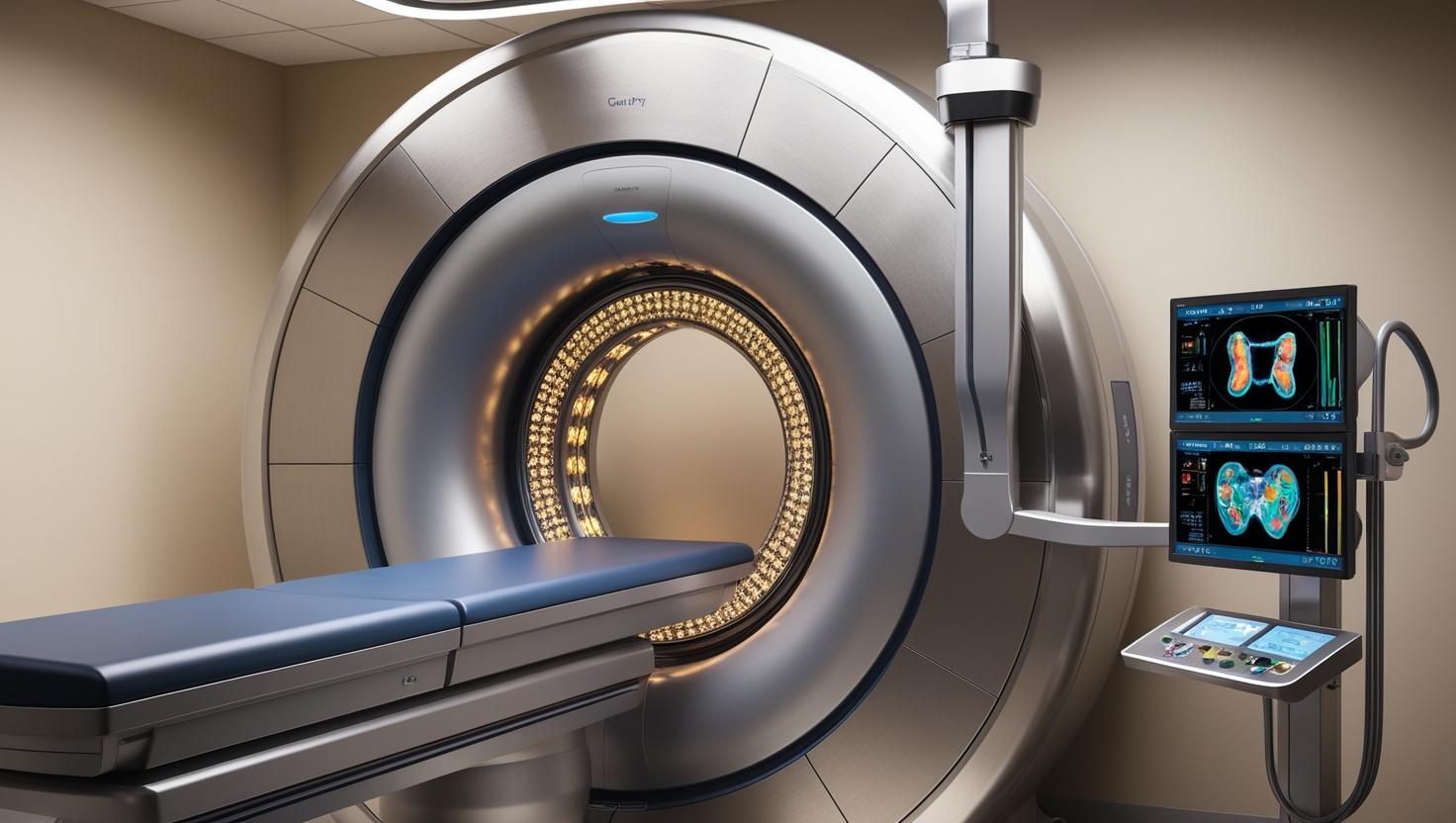
A PET scanner is a sophisticated imaging device that tracks metabolic activity by detecting gamma rays from positron-emitting radioactive tracers injected into the body. It produces detailed 3D images of biological processes, particularly useful for detecting cancer, heart disease, and neurological disorders. Modern systems combine PET with CT or MRI scanners to overlay functional and anatomical information for more accurate diagnoses. The technology excels at identifying abnormal cellular activity often before structural changes become visible. Current advancements include digital detectors that improve image quality while reducing radiation exposure and scan duration. PET plays a vital.
The 13 sections, in brief
Short summaries of each section. The full lessons, images and quizzes are in the Platform.
Overview
A man is lying very still in a dim room, and he has been told not to read, not to talk, not to move his fingers, and not to chew gum. He is confused by this, because nobody has explained it, and the instruction sounds superstitious. It is not.
Operations
The whole machine rests on one piece of physics that sounds invented. The label attached to the injected molecule is an unstable atom that decays by emitting a positron, which is an antimatter electron. That positron travels a very short distance through tissue, slows down, meets an ordinary electron, and the two annihilate each other completely.
Importance
The case for PET rests on a single capability that nothing else in routine imaging can match: it detects disease by behaviour rather than by shape, which means it can find things before they have changed shape at all. A lymph node containing metastatic cancer may be entirely normal in size, and every anatomical modality in the hospital will report it as normal, because by every structural measure it is.
Physics
Positron Emission Tomography begins with a fundamental fact of nuclear physics: certain unstable atomic nuclei spontaneously transform themselves, releasing energy and particles in the process called radioactive decay.
Features
Start here, because this is the most misunderstood thing about the entire modality. You can own the finest PET scanner ever built and it will show you nothing at all. The scanner is an empty instrument. What determines what you see is the molecule you inject, and changing that molecule changes the machine into a completely different diagnostic device without touching a single component.
Applications
Oncology, which is the overwhelming majority of what this machine does Staging, and the decision that matters most. When a cancer is diagnosed, the question that determines everything is how far it has spread. Confined disease may be curable by surgery or radiotherapy.
Physiology
Every other imaging device produces a picture of the body and lets a clinician interpret it. This one produces a picture of a process, which means that without understanding the process you are not interpreting an image at all. You are looking at bright spots and guessing.
Safety
Every other imaging device follows the same arrangement. The machine produces radiation. The patient absorbs some. Switch the machine off and the room is safe. The radiation source is injected into the patient, and the patient then walks around the hospital emitting high-energy photons for hours.
Advancements
Forget release years. What you want is the shape, because the shape predicts direction and stays true for a decade. Positron annihilation producing back-to-back photons was understood well before anyone imaged a person with it.
In Research
PET is the most quantitative imaging modality in routine clinical use. It produces an actual number, in physical units, that clinicians use to make treatment decisions every day. And that number frequently does not transfer between scanners. Or between protocols. Or between institutions.
Logistics
An engineer who understands how a PET scanner works is useful. An engineer who understands how the scanner arrives, gets licensed, gets installed, and then gets a radioactive dose delivered to it before nine o'clock every single morning runs a department or a distributorship.
Alternatives
An alternative is not a competing product. It is another way of answering the clinical question, and the honest comparison changes completely depending on what is being asked, about whom, and in what circumstances. Anyone who tells you PET is the most advanced imaging modality has said something meaningless. It answers a specific class of question superbly and is the wrong instrument for most others.
Ethical
PET raises ethical questions that most imaging does not, for four specific reasons. It delivers a radiation dose that is not trivial. It is scarce and expensive, so scanning one person means not scanning another. It can reveal a disease decades before symptoms, for conditions that may not be treatable. And it is now the gateway to a treatment, which changes the nature of the scan entirely.
Previous: Peritoneal Dialysis Cycler. Next: Phototherapy Unit. All 69 devices.
Learn it properly, inside the Platform
22 courses, the 69-device library with 13 sections per device, BMEssentials and BMEssence guides and MedTech AI. Start with a 7-day free trial, no card.
Start the 7-day free trial