
BMEssentia Platform / Device library / Phototherapy Unit
Device library
Phototherapy Unit
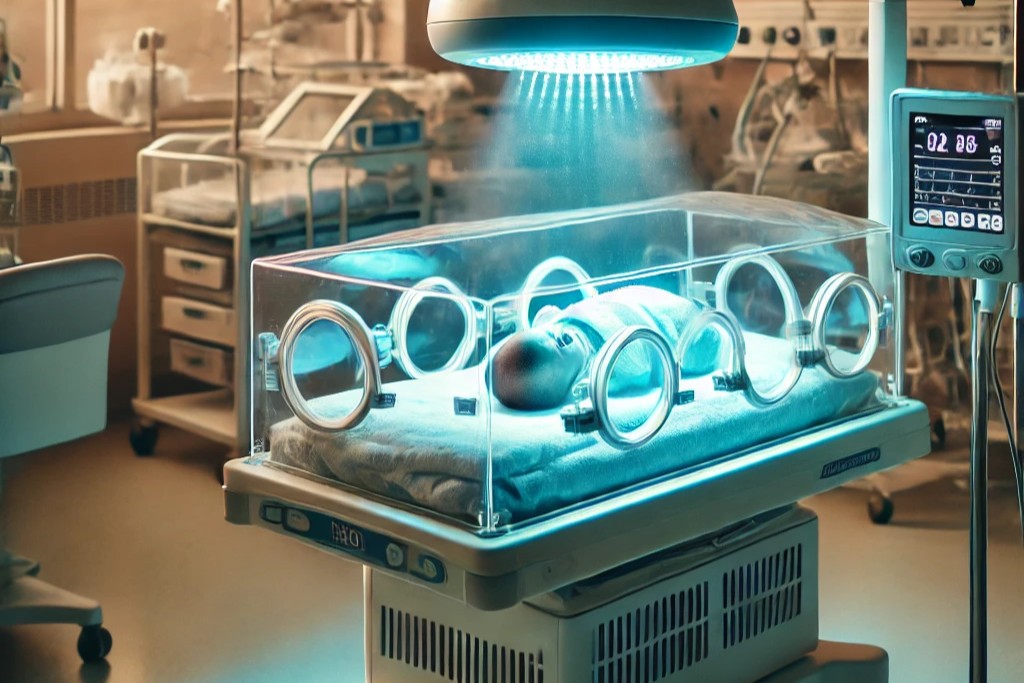
Phototherapy units are medical devices that use specific wavelengths of light, typically blue or white, to treat conditions like neonatal jaundice, psoriasis, and seasonal affective disorder. The therapy works by breaking down excess bilirubin in newborns' blood into a form that can be easily excreted, preventing potential brain damage. First introduced in the 1950s, modern phototherapy systems now feature LED lights that are more energy-efficient and emit targeted wavelengths without harmful UV radiation. These units are calibrated to deliver precise light intensity measured in microwatts per square centimeter per nanometer. Research shows phototherapy can also stimulate vitamin D.
The 13 sections, in brief
Short summaries of each section. The full lessons, images and quizzes are in the Platform.
Overview
A baby boy is four days old. He was born a little early, a week or two before his due date, and went home with his mother the day after birth. Feeding has been hard. He falls asleep at the breast after a few sucks. His nappies are fewer and drier than they should be. His parents think he is just a sleepy baby.
Operations
Follow the light from the lamp, into the baby's skin, through the blood, and out of the body. It starts with a decision made on paper, not on sight. A blood sample, or a skin meter reading confirmed by blood, gives a bilirubin level.
Importance
The first argument is about preventing brain damage that cannot be undone. Newborn jaundice is extremely common. Most babies have some yellowing in the first days. In most it is harmless and fades. In a smaller number, bilirubin rises high enough to threaten the brain.
Physics
Physics Involved in the Phototherapy unit: Concept 1, Principle of Light-Based Therapy in Phototherapy Units A phototherapy unit is a medical device that uses carefully controlled light energy to treat biological tissues. Its most well-known clinical use is in neonatal jaundice, where newborns develop high levels of bilirubin in their blood.
Features
The colour of the light, and why only blue does the work Imagine treating a jaundiced baby with ordinary white room light, only brighter. Most of that light would be wasted. Bilirubin absorbs light most strongly in the blue part of the spectrum, with some absorption into blue-green. Red, orange and yellow light pass through bilirubin almost untouched.
Applications
Every use of this device is one of four things. Treating ordinary newborn jaundice that has climbed too high. Holding back rapid jaundice while its cause is found. Protecting premature and sick babies whose brains are more vulnerable. And managing rare conditions where the liver never learns to cope.
Physiology
Where bilirubin comes from, and why newborns make so much of it. Why a newborn's liver cannot keep up. How bilirubin travels in the blood, and when it slips free. How the gut can send bilirubin back into the body. How blue light reshapes bilirubin in the skin. And what bilirubin does when it reaches the brain.
Safety
The greatest danger with this device is not the light itself, but a baby who is believed to be treated when they are not. The most common harm in phototherapy is a dose too small to work, delivered by a unit that looks like it is working. A baby under a blue glow reassures everyone who walks past.
Advancements
Forget release years. This device has a clear shape: it began with an observation in sunlight, became a lamp, learned it was a drug that needed a dose, and is now learning how to deliver that dose everywhere, safely, to every baby who needs it. The sunlight observation, when staff noticed that jaundiced skin exposed to sunlight faded while covered skin stayed yellow.
In Research
Nobody knows exactly how much light each baby needs, or how much is too much for the smallest Phototherapy is one of the oldest and most widely used treatments in newborn care. Yet the field still cannot say, for a given baby, what dose of light is enough, what dose is wasted, and at what point more light starts to carry its own risk.
Logistics
An engineer who understands this device is useful. An engineer who understands that a phototherapy unit is sold as a lamp but must be maintained as a medicine, with a dose that fades silently unless someone measures and replaces it, understands what is actually being delivered.
Alternatives
An alternative is not a competing product. It is another way of answering the clinical question, and here the question is: how do we lower this baby's unconjugated bilirubin fast enough to protect the brain, and stop whatever is producing it? Phototherapy answers the first half of that question better than anything else so gentle.
Ethical
Phototherapy protects a brain that cannot speak for itself, and every failure is paid for by someone who will never know it happened. The patient is days old. They cannot say they feel sleepy. They cannot ask whether the lamp is at the right height. They cannot notice that half their skin is under a blanket. Everything depends on the adults around them noticing, measuring and acting.
Previous: PET Scanner. Next: Positron Emission Mammography (PEM) Scanner. All 69 devices.
Learn it properly, inside the Platform
22 courses, the 69-device library with 13 sections per device, BMEssentials and BMEssence guides and MedTech AI. Start with a 7-day free trial, no card.
Start the 7-day free trial