
BMEssentia Platform / Device library / Positron Emission Mammography (PEM) Scanner
Device library
Positron Emission Mammography (PEM) Scanner
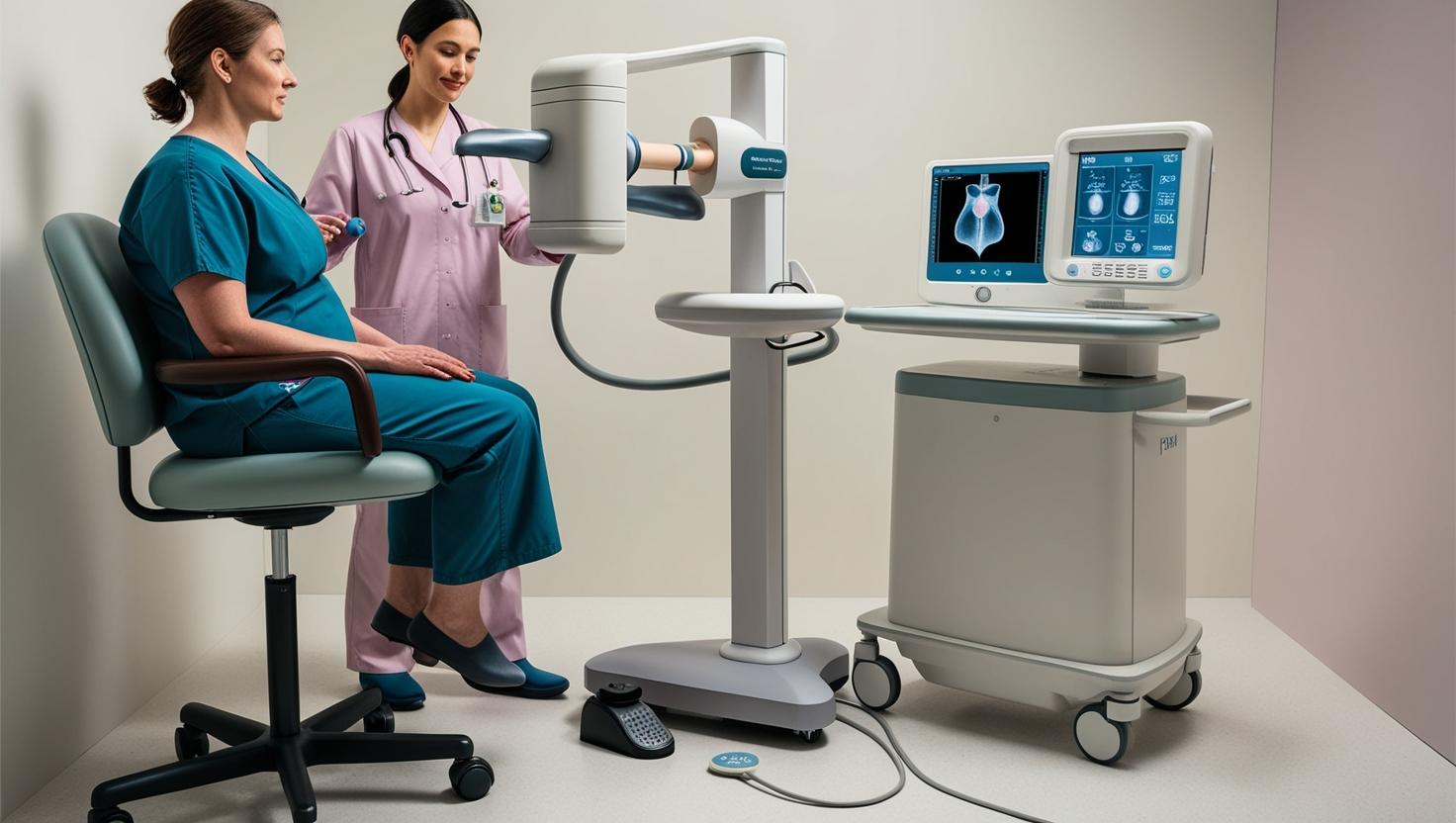
Positron Emission Mammography (PEM) scanners, introduced in the early 2000s, use radioactive tracers like 18F-FDG to detect breast cancer with higher resolution than whole-body PET scans, spotting tumors as small as 1.5 to 2 mm. Unlike traditional mammography, PEM focuses on metabolic activity, making it ideal for dense breasts where X-rays struggle. Recent low-dose PEM advancements reduce radiation exposure to levels comparable to mammography, minimizing risks while maintaining 96% detection accuracy. These scanners, like the PEM Flex Solo II, apply mild breast compression and offer faster imaging, aiding early diagnosis and treatment planning
The 13 sections, in brief
Short summaries of each section. The full lessons, images and quizzes are in the Platform.
Overview
A woman is sitting upright in a chair with her breast held between two flat plates, gently compressed, exactly as she would be for a mammogram, except that nothing is being sent through her.
Operations
Follow the patient and the machine explains itself. She fasts, because circulating glucose competes with the tracer for the same cellular transporters and a high blood sugar dilutes the signal she is paying radiation for. Blood glucose is measured.
Importance
The case for this machine rests on one claim that is genuinely true and narrower than its advocates usually state: it detects small metabolically active lesions in the breast better than a whole-body PET scanner can, and it answers questions that anatomical imaging leaves open. The resolution advantage over whole-body PET is real and it comes from geometry rather than from any clever engineering.
Physics
Physics Involved in Positron Emission Mammography (PEM): 1, Positron Emission and Annihilation Photon Generation At the foundation of Positron Emission Mammography (PEM) lies a moment of exquisite symmetry: the annihilation of matter and antimatter.
Features
The geometry argument, which is the whole machine A whole-body PET scanner is a ring of detectors sixty to eighty centimetres across, because it has to fit a human torso inside it. That dimension is not chosen. It is forced by the requirement to scan everybody.
Applications
Breast imaging already has three established modalities, all of them good, all of them installed nearly everywhere. Which means this section cannot be a list of things the machine can do. It has to be a list of things the other three cannot, and that list is short, specific, and genuinely real.
Physiology
This machine produces a map of a biological process, which means the physiology is not background to the device. It is the image. A mammogram can be interpreted, imperfectly, by someone who knows anatomy. This cannot be interpreted at all by someone who does not know what the tracer does inside a cell, because every bright and dark region on the screen is a statement about metabolism rather than about structure.
Safety
This device inverts the arrangement that breast imaging normally follows, and the inversion is the whole safety story. In a mammography room the machine produces radiation, the breast absorbs a small localised dose, and switching the machine off makes the room safe. Nothing leaves with the patient.
Advancements
Forget release years. The shape is what predicts direction, and the shape of this device is unusual because it is the story of a technology that worked and did not spread. Whole-body PET established that metabolism could be imaged, and breast oncologists immediately noticed the limitation: a ring built for a torso resolves to about a centimetre, and breast lesions that matter are smaller than that.
In Research
Most devices in this library are enormously studied and have foundational gaps in their practice. This one has the opposite problem. It barely has a literature at all. There are a small number of systems worldwide.
Logistics
For most devices in this library, logistics determines cost and convenience. For this one, logistics is the reason the device is rare. The engineering works. The physics is sound. The clinical case in its narrow indications is real. And it has barely deployed, because a breast imaging unit that buys one discovers it has agreed to build a nuclear medicine service around it.
Alternatives
An alternative is not a competing product. It is another way of answering the clinical question, and the honest comparison changes completely depending on what is being asked, about whom, and in what circumstances. And this section is different from every other in the library, because for most devices the alternatives are the supporting cast.
Ethical
Most ethical sections in this library concern a machine that is widely used. This one concerns a machine that is barely used, which produces a different and sharper set of questions. A systemic radiation dose delivered to answer a question about one organ, in a field that already has a modality using no radiation at all.
Previous: Phototherapy Unit. Next: Prosthetic Limbs. All 69 devices.
Learn it properly, inside the Platform
22 courses, the 69-device library with 13 sections per device, BMEssentials and BMEssence guides and MedTech AI. Start with a 7-day free trial, no card.
Start the 7-day free trial