
BMEssentia Platform / Device library / Transcranial Doppler Ultrasound (TCD)
Device library
Transcranial Doppler Ultrasound (TCD)
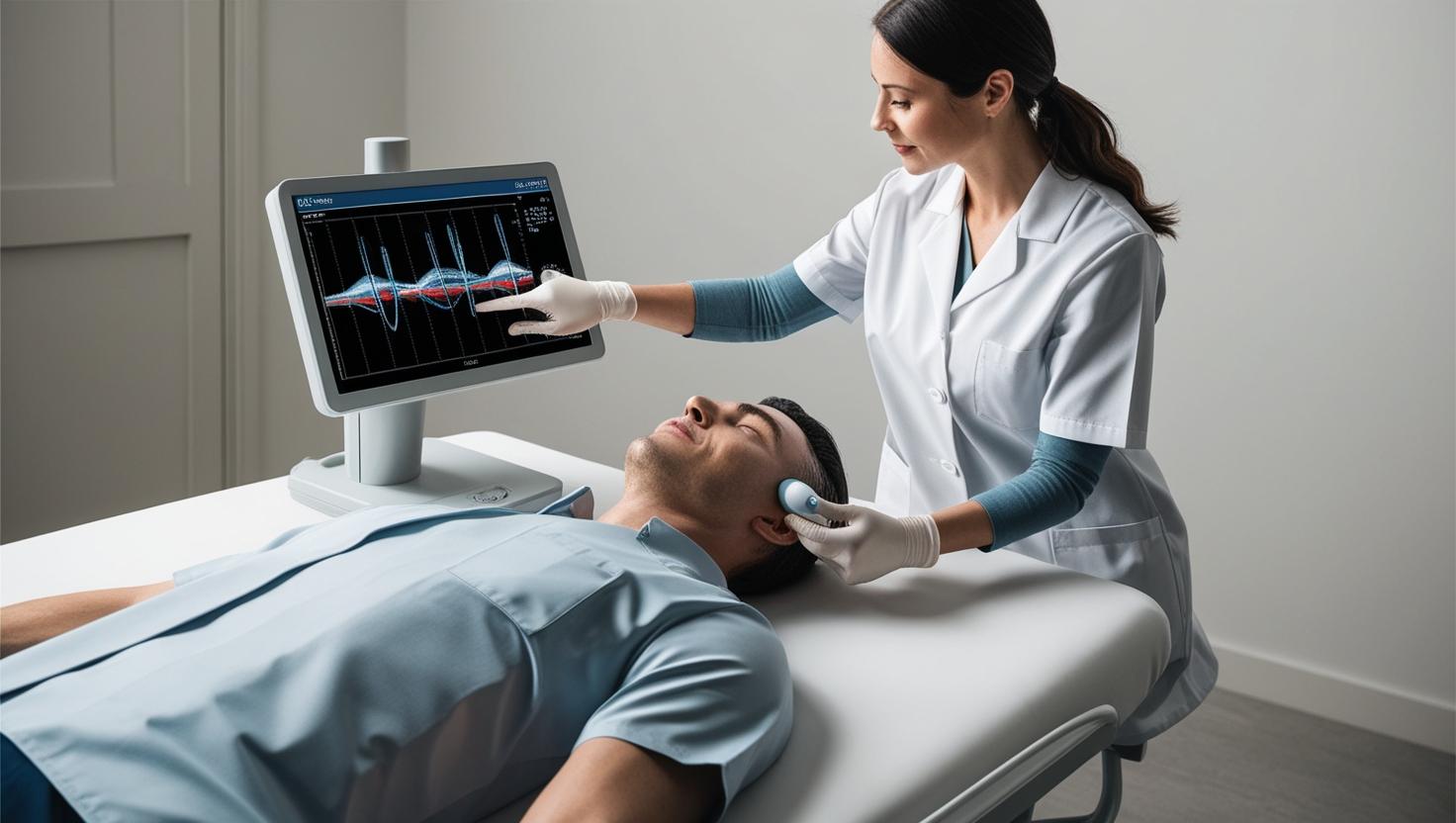
Transcranial Doppler Ultrasound (TCD), developed in the 1980s, uses sound waves to measure blood flow in brain arteries non-invasively. By detecting velocities as low as 10 cm/s through the skull, TCD helps diagnose stroke, vasospasm, or sickle cell disease complications. Portable modern TCD devices allow bedside monitoring, and some integrate robotics for precise probe placement. It's critical in neurocritical care, with applications like detecting emboli during surgery, improving patient outcomes without radiation exposure.
The 13 sections, in brief
Short summaries of each section. The full lessons, images and quizzes are in the Platform.
Overview
A child of six with sickle cell disease is lying still while somebody holds a probe against the side of her head, just in front of her ear. There is no picture. On the screen there is a waveform and a number, and the number is 210.
Operations
Follow the beam, then follow the operator's reasoning, because in this device they are separate skills. It starts with a low frequency probe, typically around two megahertz, which is far lower than almost anything else in ultrasound. Low frequency because bone attenuates severely and attenuation rises with frequency.
Importance
The first argument is about a single group of patients and it is one of the largest effects any device in this library produces. Children with sickle cell disease have a high risk of stroke, and transcranial Doppler screening identifies who. Sickled red cells damage the lining of the arteries at the base of the brain, which narrow.
Physics
Physics Involved in the Transcranial Doppler Ultrasound Device: Concept 1, Core Acoustic Architecture and Hemodynamic Signal Formation in Transcranial Doppler Ultrasound A Transcranial Doppler (TCD) ultrasound system is an elegant acoustic instrument designed to peer through the human skull and measure the velocity of blood flowing through cerebral arteries in real time.
Features
Start with the number that shapes the whole device. Bone attenuates ultrasound severely, and attenuation rises steeply with frequency. A probe at the frequencies used for abdominal scanning would lose essentially all of its energy in the skull and return nothing.
Applications
The strongest evidence for this device and one of the strongest in the library. Sickled red cells damage the lining of arteries, and the large arteries at the base of the brain narrow progressively. Children with sickle cell disease have a high risk of stroke, and a stroke in childhood is a lifetime of disability.
Physiology
How the brain's arteries are arranged, why velocity is not flow, how the brain controls its own blood supply, and what happens when pressure inside a closed box rises. The anatomy that makes this device possible and makes it interpretable. The two internal carotid arteries come up the front of the neck and supply most of each cerebral hemisphere.
Safety
This device is physically among the safest in the library, and that is not where its risks are. There is no radiation, no contrast, no needle and no contact with anything sterile.
Advancements
Forget release years. This device has an unusual shape: it was invented for one problem, expanded far beyond what the evidence supported, contracted again, and is now being rebuilt around the uses that survived. Somebody worked out that a low enough frequency gets through thin skull. That single realisation created the field, because the received wisdom was that ultrasound and the adult brain were incompatible.
In Research
The device that was proven and then doubted Transcranial Doppler has one of the strongest results in paediatric medicine attached to it and a general reputation for unreliability. Both of those are correct, and holding them together is the whole intellectual problem of this device. The measurement is real: velocity in a cerebral artery predicts stroke in sickle cell disease well enough to stop a trial early.
Logistics
An engineer who understands this device is useful. An engineer who understands that this is one of the cheapest devices in the library and one of the hardest to actually run understands what is being sold. The machine is affordable, portable, needs no shielding, no radiation licence, no contrast and almost no consumables. And a unit that buys one without a trained operator has bought a trolley.
Alternatives
An alternative is not a competing product. It is another way of answering the clinical question, and here the split is unusually clean. If you want to know what the arteries look like, everything else is better. If you want to know what they are doing right now, and again in an hour, at the bedside, almost nothing else exists.
Ethical
This device is used in two situations where almost nothing else in the library goes. It is used to screen healthy children so that some of them can be given lifelong transfusions, and it is used to help confirm that somebody's brain has died. Both of those are decisions with no way back, taken partly on the strength of a number obtained blind through a thin patch of skull by one person who cannot be checked.
Previous: Thermometer. Next: Transcutaneous Electrical Nerve Stimulator (TENS). All 69 devices.
Learn it properly, inside the Platform
22 courses, the 69-device library with 13 sections per device, BMEssentials and BMEssence guides and MedTech AI. Start with a 7-day free trial, no card.
Start the 7-day free trial