
BMEssentia Platform / Device library / Urodynamic Testing System
Device library
Urodynamic Testing System
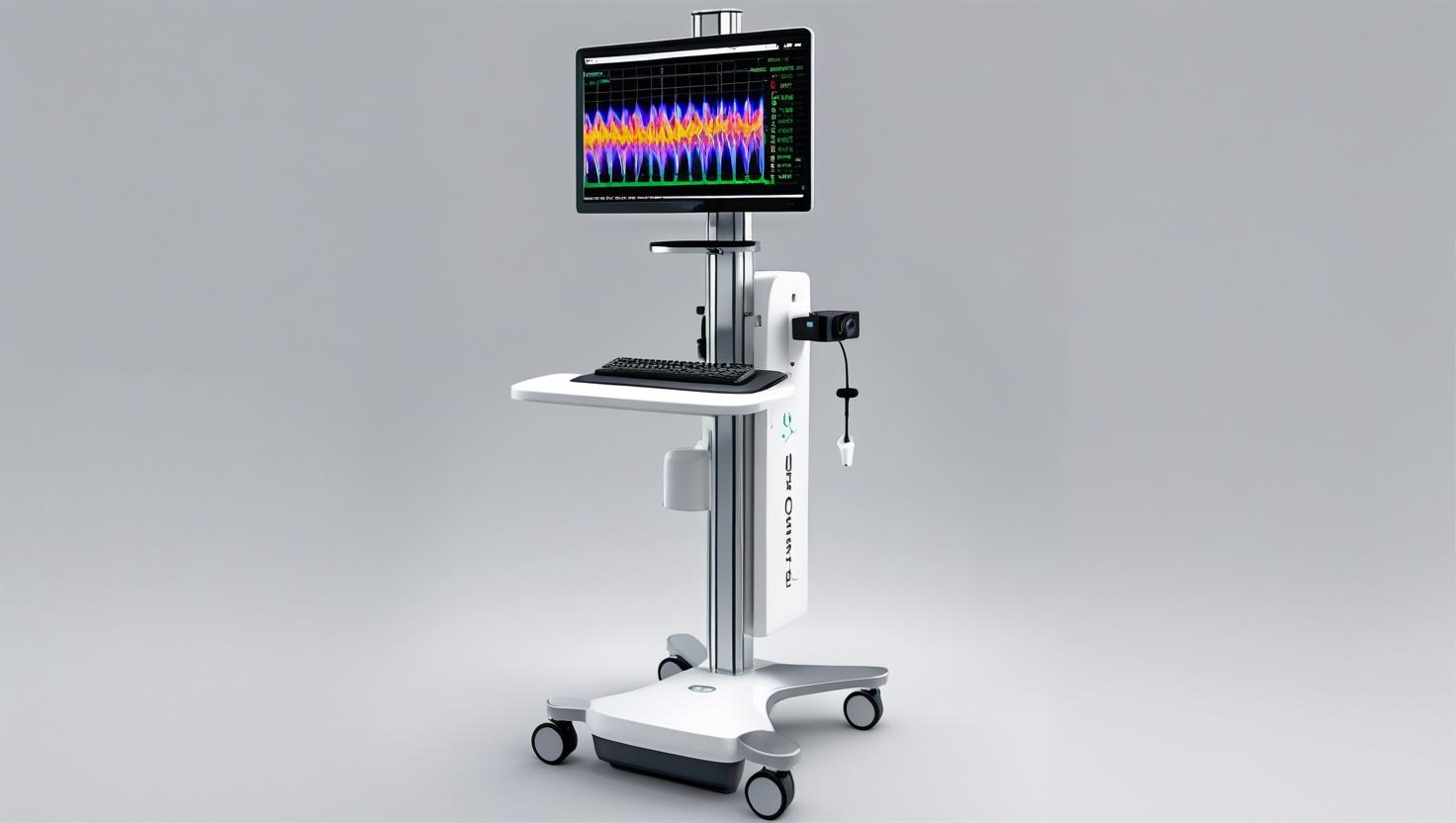
Urodynamic testing systems, used since the 1970s, evaluate bladder and urethral function to diagnose issues like incontinence or urinary retention. These systems use catheters and sensors to measure bladder pressure, urine flow, and muscle activity, often with real-time imaging like X-rays. Modern setups, like the Laborie NXT, are portable and use AI to enhance accuracy, reducing infection risks with single-use catheters. They help tailor treatments by pinpointing issues like detrusor overactivity or sphincter dysfunction.
The 13 sections, in brief
Short summaries of each section. The full lessons, images and quizzes are in the Platform.
Overview
A woman of sixty-three is sitting on a commode chair in a small room. There is a catheter in her bladder, another in her rectum, adhesive electrodes on her perineum, and three people she met twenty minutes ago are watching a screen while her bladder is slowly filled with saline.
Operations
Follow the pressures, then follow the patient. It starts with a free flow study before anything is inserted. The patient arrives with a comfortably full bladder and passes urine into a measuring device, alone, with the door closed. This is the only part of the whole test that resembles normal voiding, and it gives a baseline flow rate to compare against everything that follows.
Importance
The first argument is about surgery, and it is the reason the test exists. Incontinence surgery is largely irreversible, and the two main types of incontinence are treated in completely opposite ways. Stress incontinence is a failure of the closure mechanism, and it is treated by supporting or tightening the urethra.
Physics
Physics Involved in the Urodynamic Testing System: Concept 1, Fluid-Pressure Transduction and Bladder Dynamics (Urodynamic Testing System) Inside a urodynamic setup, every data point originates from a single physical act, the deflection of a sensing membrane under hydrostatic load.
Features
Start here, because this is the whole device. The bladder is an abdominal organ. Anything that raises abdominal pressure raises the pressure inside it. So a catheter in the bladder measures the bladder muscle's own contraction plus whatever the abdomen is doing, added together and indistinguishable.
Applications
Every use of this device is one of three things. Deciding which operation somebody should have. Finding out why somebody cannot empty. Or protecting kidneys in a patient who feels nothing. The third is the one that saves lives and the one nobody outside urology has heard of.
Physiology
How a bladder stores without pressure rising, how continence is maintained, how voiding is coordinated, why a pressure is dangerous to kidneys, and why the whole system is under voluntary control at all. The property that makes normal storage possible and whose loss destroys kidneys.
Safety
This device has a small set of real physical risks and one large harm that is not usually counted as one. The dignity cost is the dominant harm, and it is systematically excluded from every risk assessment because it does not fit the categories. Patients are catheterised, given a rectal balloon, filled until uncomfortable, and then deliberately made to leak in front of strangers.
Advancements
Forget release years. This device has an unusual shape: the measurement was solved early, standardisation mattered more than technology, and the most important recent development has been deciding to do the test less often. Somebody measured the pressure inside a filling bladder and demonstrated that it stays low, which established that the bladder is not a passive balloon.
In Research
A test that does not reliably predict what treatment will work Urodynamics measures bladder function accurately. What it does less well is predict outcomes. The relationship between urodynamic findings and response to treatment is weaker than the confidence with which the test is used, and that is the uncomfortable centre of the whole field.
Logistics
An engineer who understands this device is useful. An engineer who understands that the room matters as much as the machine understands what is actually being sold. A urodynamic study requires a private room with a toilet or commode, space for a commode chair, somewhere for the patient to undress and void unobserved for the free flow study, and enough separation that they are not audible from a waiting area.
Alternatives
An alternative is not a competing product. It is another way of answering the clinical question, and here the questions are genuinely different from one another. Deciding which operation somebody should have. Finding out why somebody cannot empty. And knowing whether a bladder is damaging kidneys.
Ethical
This test requires somebody to do, in front of strangers, the thing they are most ashamed of. Urinary incontinence is among the most concealed conditions in medicine. People hide it from their partners for years. They stop exercising, stop travelling, plan every outing around toilets, and frequently present only when it becomes unmanageable.
Previous: Ultrasound (SONAR) Machine. Next: Vagus Nerve Stimulator (VNS). All 69 devices.
Learn it properly, inside the Platform
22 courses, the 69-device library with 13 sections per device, BMEssentials and BMEssence guides and MedTech AI. Start with a 7-day free trial, no card.
Start the 7-day free trial